
Trade Bait: Robert Thomas
Best on the board

As we approach the 2025-26 trade deadline, the Blues are in prime position to sell. They sit 14 points outside the playoff picture and hold some of the biggest names on the market:
Jordan Kyrou
Brayden Schenn
Pavel Buchnevich
Justin Faulk
Some have speculated that Robert Thomas is available to the highest bidder too. If there’s any truth to these rumors, he immediately becomes the main attraction. Ahead of his return from a leg injury/personal leave of absence (due back on Friday), let’s explore what he brings to the table.
Puck Support
Thomas thrives at one of the least exciting yet most important parts of playing center in the NHL: puck support. His positioning ensures that the Blues remain in good shape during his shifts, assisting D-men below the goal line, bolstering the squad’s transition game and scooping up loose change to extend offensive waves. It’s textbook stuff that fortifies St. Louis’ ranks around the puck.
While you may not notice his insulation at a glance, you can feel how much sturdier the team’s foundation is when he’s out there:
The 2017 first-rounder is a dependable breakout target who does an excellent job of straddling his defensive and transitional responsibilities. He stays on the right side of the puck and waits for opportunities to double-team opponents without jeopardizing the Blues’ structure (e.g. opponent has their back turned to the play, bobbled pucks, etc.). Once they recover possession down low, he swings so close to the puck-carrier that it’s damn near impossible to miss him.
On later relays, he flashes his next-pass foresight, recognizing the opposition’s leverage and the area he should occupy to facilitate a link-up for St. Louis’ high wall man.
Offense-first pivots have a habit of forcing the back line to fend for itself, whereas the conservative bias of defensive centers often hinders their ability to grease the wheels. Thomas strikes that balance with ease:
No matter where the play proceeds, his routes lead him to the point of attack first. The inside lane belongs to him. That boils down to anticipation over velocity. His top gear may be impressive (93rd percentile), but he’s clocked ONE 22+ mph burst over the past two seasons. It’s his timing that detects green lights and produces just enough pace for him to wriggle free before resuming his role as a Steady Eddie safety net.
He doesn’t devote his energy to slicing through the NZ on his own. He travels to and from the shadows as the need for numbers around the puck arises. Naturally, this investment in the team concept bolsters a five-man unit that seldom runs out of options.
Here’s an example that features his pathing and passing:
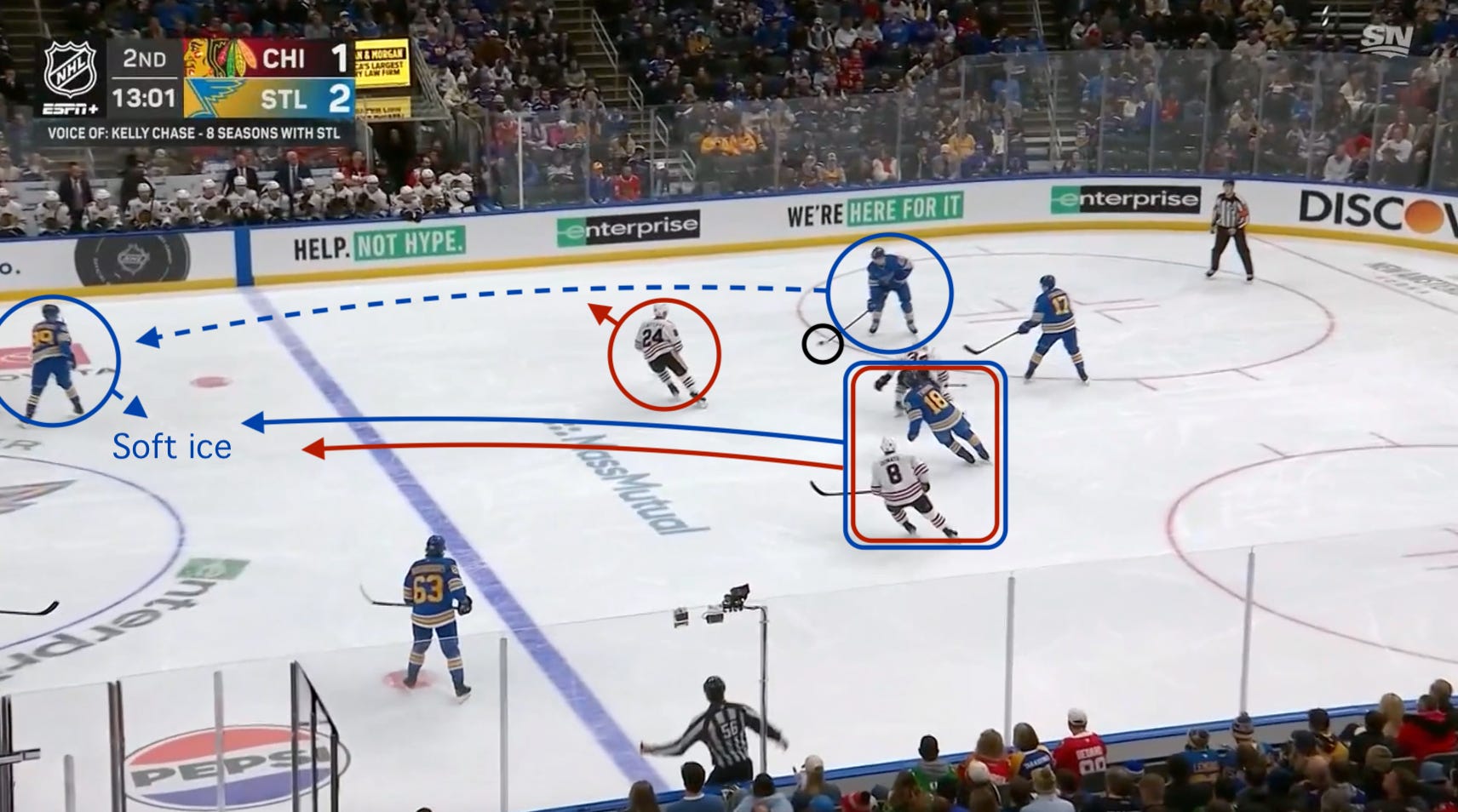
Following a short D-to-D, Thomas (STL 18) senses that Colton Parayko (STL 55)—a meat-and-potatoes defender—will likely opt for the strong-side out over an incisive middle-ice feed. Wyatt Kaiser (CHI 44, off screen) has Pavel Buchnevich contained, so the winger requires an outlet for the Blues to build some tempo.
In other words, a race to the proverbial spot is on between Thomas and his counterpart (Ryan Donato, CHI 8):
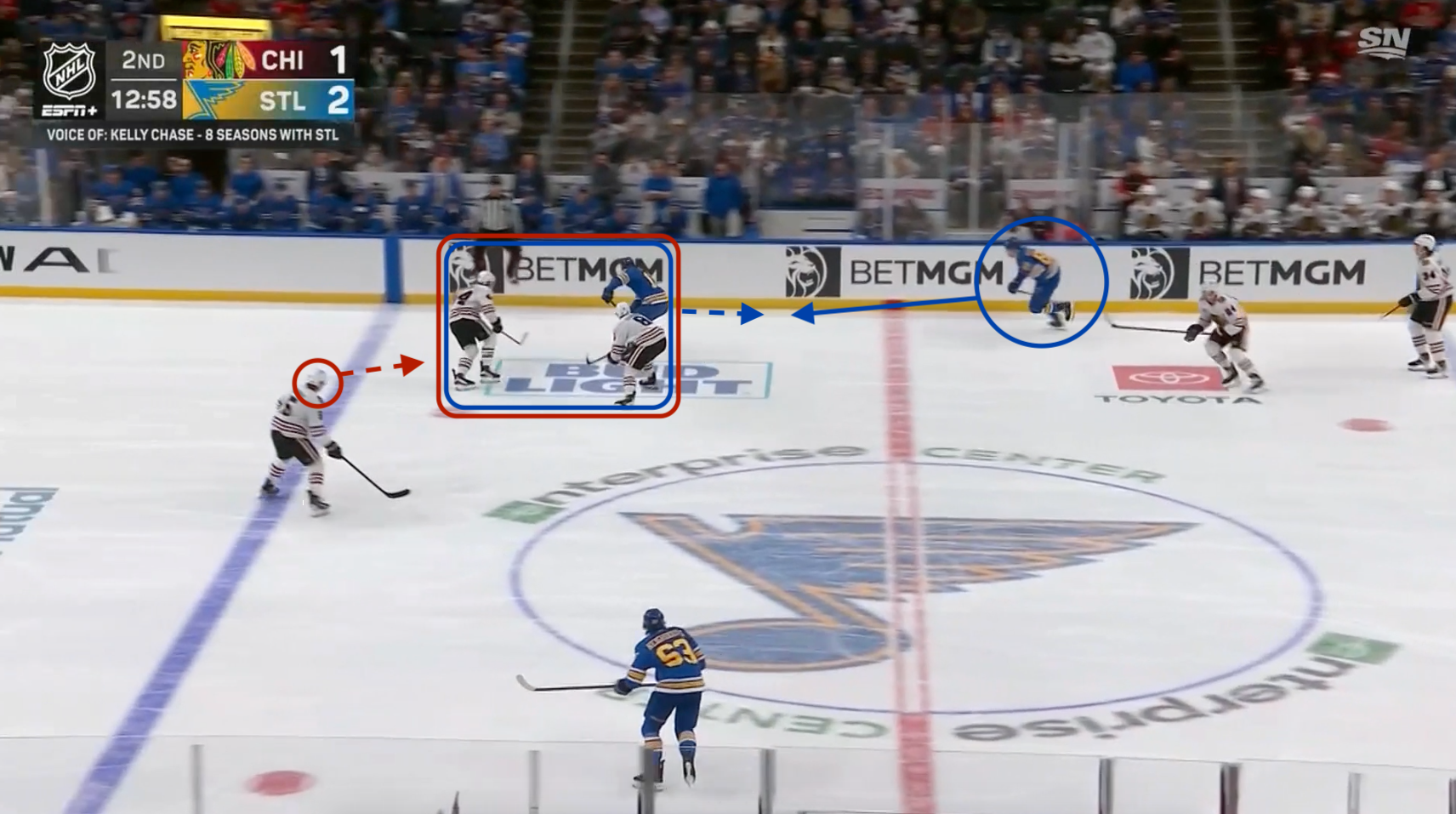
Thomas’ processing grants him a short-lived victory. He does catch in stride, but now both Donato and Kaiser are flushing him toward an impasse. How can he maintain his team’s speed? By hooking up with the trailer:
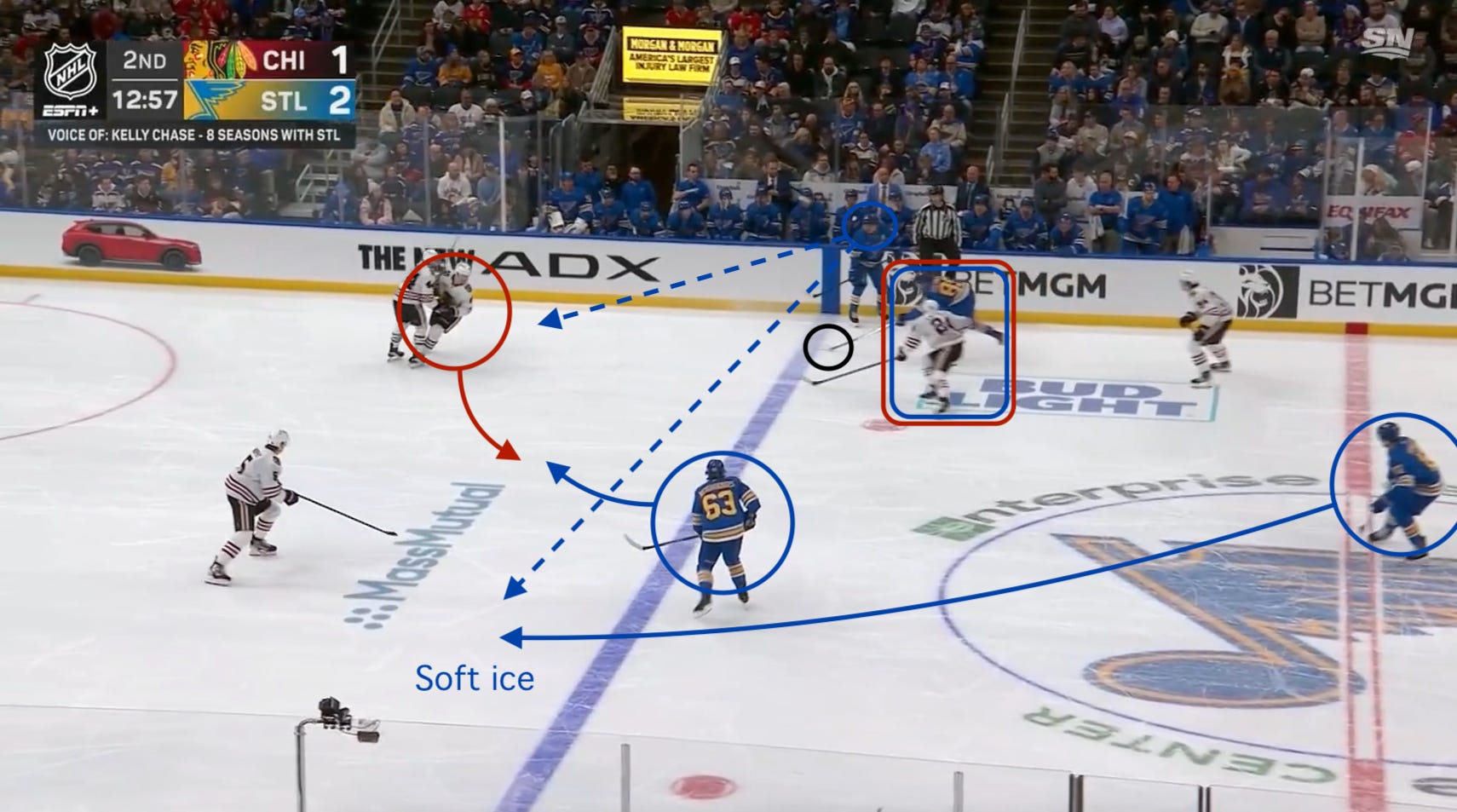
Since Sam Lafferty (CHI 24) is poised to cut Buchnevich off, the Russian sends the puck back to Thomas. In advance of this feed, the center scans to identify the wisest course of action. Donato is set to cover Jake Neighbours (STL 63), while Cam Fowler (STL 17) has the gap to join the fray from the back end.
Side switch —> massive cushions:
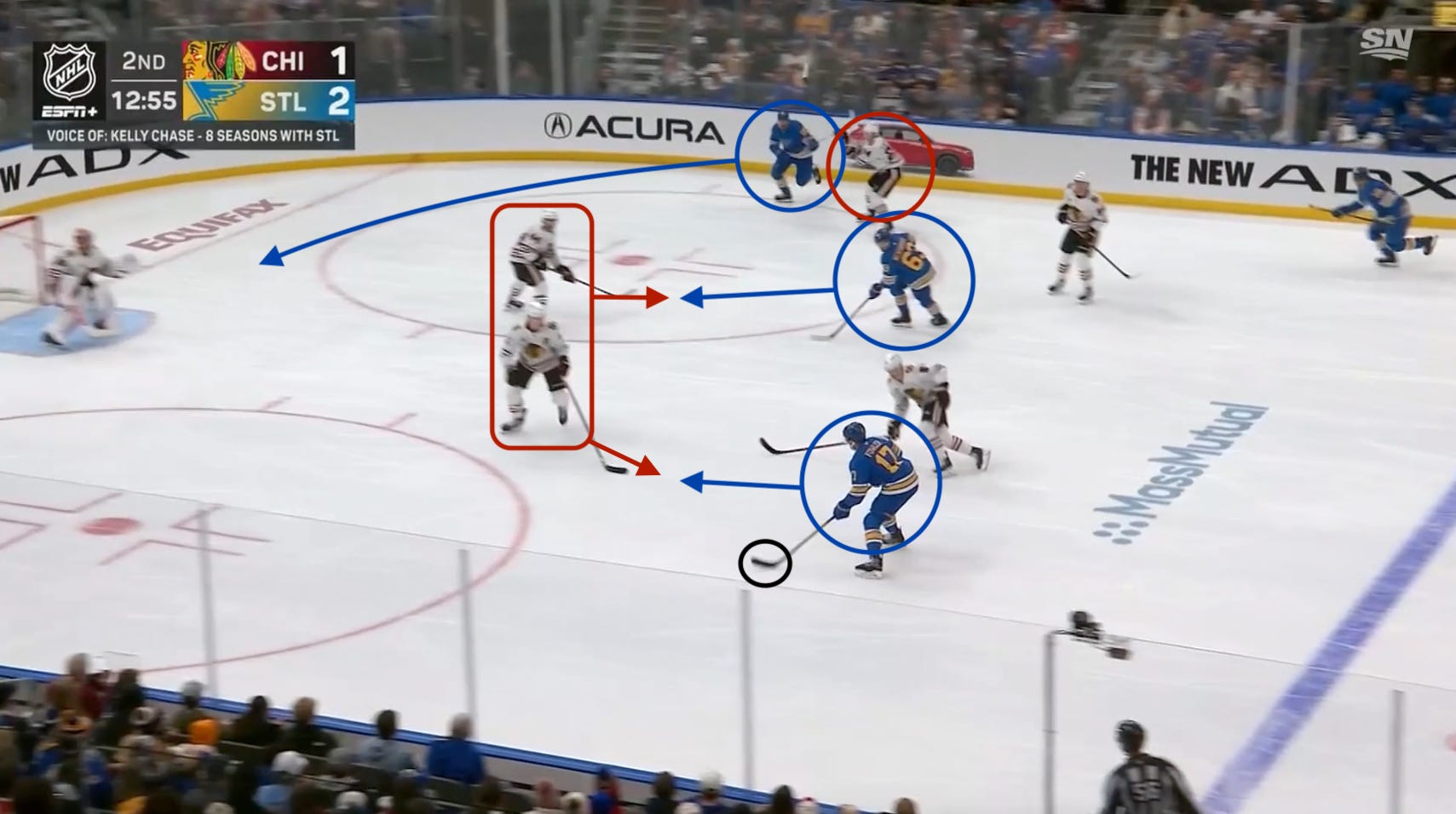
Although nothing comes of this sequence, it demonstrates the fluidity, smarts and precision with which Thomas operates. Each time the Blues encounter a NZ obstacle, he has a vertical or lateral answer to ease their progress:
The initial bump outlet to start heading north.
The drop to preserve momentum.
The east-west pass to navigate around Chicago’s strong-side pressure.
The deepest Blue at the start of this play ends up leading the offensive charge. That’s team cohesion at work:
Thomas’ dot-connecting skills translate to the forecheck as well. Within the old dog-fox-hawk taxonomy (i.e. F1/F2/F3), the second part comes naturally to him, as he’ll float until there’s a chance to overwhelm the opposition and extract the puck. Show your cards too soon, and defenders will out-muscle him (he doesn’t play a heavy brand of hockey). Arrive too late, and the F1 is left stranded on an island. It’s that balance yet again:
Beyond his passing talent (see: next section), he enhances the Blues’ attack through his vigilance in pursuit. He’s ever-prepared to shed his F3 skin for the F2 variety, swooping in to contest 50/50 pucks or snag loose ones outright after F1 has affected the opposition’s retrieval. The first man in can bank on his presence along the boards.
St. Louis can depend on him to wrestle the inside track away in most situations. Below the DZ goal line? Check. NZ? Yessir. On the forecheck? You got it.
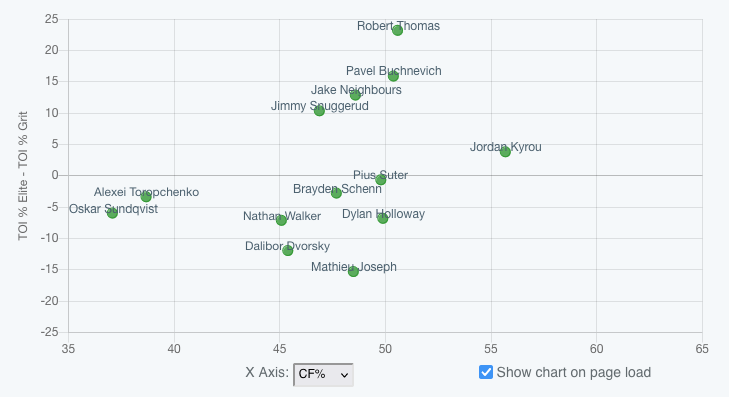
Consequently, the team enjoys some semblance of a handle on proceedings during his TOI. Breaking even in shot attempt share (50.4 CF%) may not seem notable at first blush, but he’s absorbing the toughest minutes up front on a 20-28-9 (read: bad) squad that ranks 27th in CF%:
Tack on solid defensive instincts and an active stick, and you’ve got a 200-foot stalwart:
St. Louis’ personnel may have failed Thomas this season, but Jim Montgomery’s system has still highlighted the pivot’s finest qualities. His reliability. His feel for the flow of traffic. His opportunistic streak. The sum of these attributes amounts to a stable three-zone conscience.
And much like with Nick Suzuki (another star center whose game speaks in lowercase rather than shouting from the rooftops), that’s only half of the equation.
Playmaking
Thomas is best known for his distribution, and rightfully so. Not only is he a prolific playmaker, but he’s also the definition of a pass-first forward:
Among the league’s top 40 assist men at 5-on-5 this season, just two forwards (Radek Faksa and Ryan McLeod) have registered a lower shot attempt rate. It’s not as though he’s a poor finisher. He’s hit the 20-goal plateau on three occasions and the two finest seasons of his career have coincided with high-water marks in volume. The problem is convincing him to pull the trigger. Style-wise, he’s not wired to be a dual threat.
Fortunately for the Blues—or whichever club lands him at the deadline—he’s an ace in his preferred dimension. Even if you sag off to defend the pass, his vision and touch can carve you apart:
The bulk of the game (~80% if memory serves) transpires along the wall. Premier playmakers must therefore display an aptitude for peeling the puck off the kickplate and teeing up teammates in the slot. Thomas has carried that burden in St. Louis for years, and his passes have proven difficult to contain.
As a right-hand shot, he likes the left boards and prioritizes timing over sizzle. The moment off-puck defenders turn away from or become engrossed by his possession, he’ll slip a pass into the belly of the beast. The pivot complements his swiftness with impressive diversity. He’ll set up the strong-side trigger man in the high slot, the weak-side slasher, the point man sinking into middle ice, etc. He can deliver rapid-fire connections or silky sauce. Regardless of his grip (forehand vs. backhand), his accuracy doesn’t suffer.
He’s one of the purest passers around:
Active five-man offenses would benefit most from Thomas’ gifts. He’d have a much more pronounced effect in, say, Tampa Bay than in Ottawa. After all, more movement = more windows to exploit.
In addition to his vision, he flashes wonderful passing weight and deception at times. Consider this example vs. the Golden Knights:
Kyrou’s (STL 25) flick down the boards initiates a two-man game with Thomas in order to dash Vegas’ high pressure, swap marks from Colton Sissons (VGK 10) to Mitch Marner (VGK 93) and gather enough speed to attack the latter’s blind spot. Marner does well to shoulder-check for Kyrou. Unfortunately for him, Thomas’ eyes sell point pass and both Golden Knights forwards bite:
Sissons’ stick position moves from slot to point denial.
Marner, a takeaway-chaser to the fullest degree, shimmies up in hopes of jumping a pass above Sissons’ depth. That grants Thomas the sliver of daylight he requires to feather the puck to Kyrou in prime real estate.
While he’s already established himself as a high-end passer, there’s further upside to mine. On a club with dynamic weapons, he could unlock a freer and more improvisational bent. He possesses the tools for it:
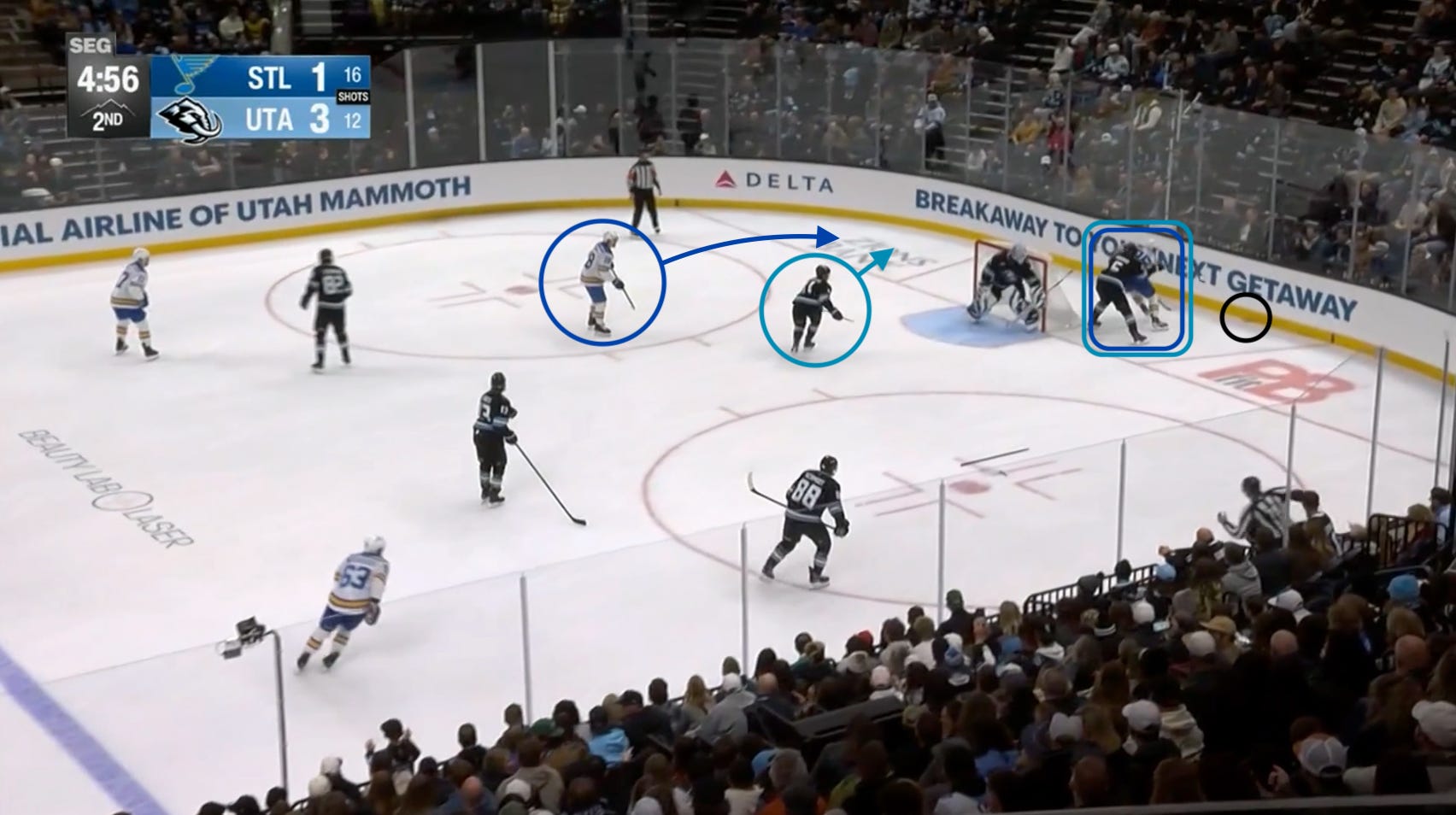
As Kyrou tries to corral a rim vs. John Marino (UTA 6), Thomas and Dylan Guenther (UTA 11) lock horns in the battle for puck support. We saw in the previous section how regularly he snatches the inside track away from his counterpart, but he diverts from that plan early:
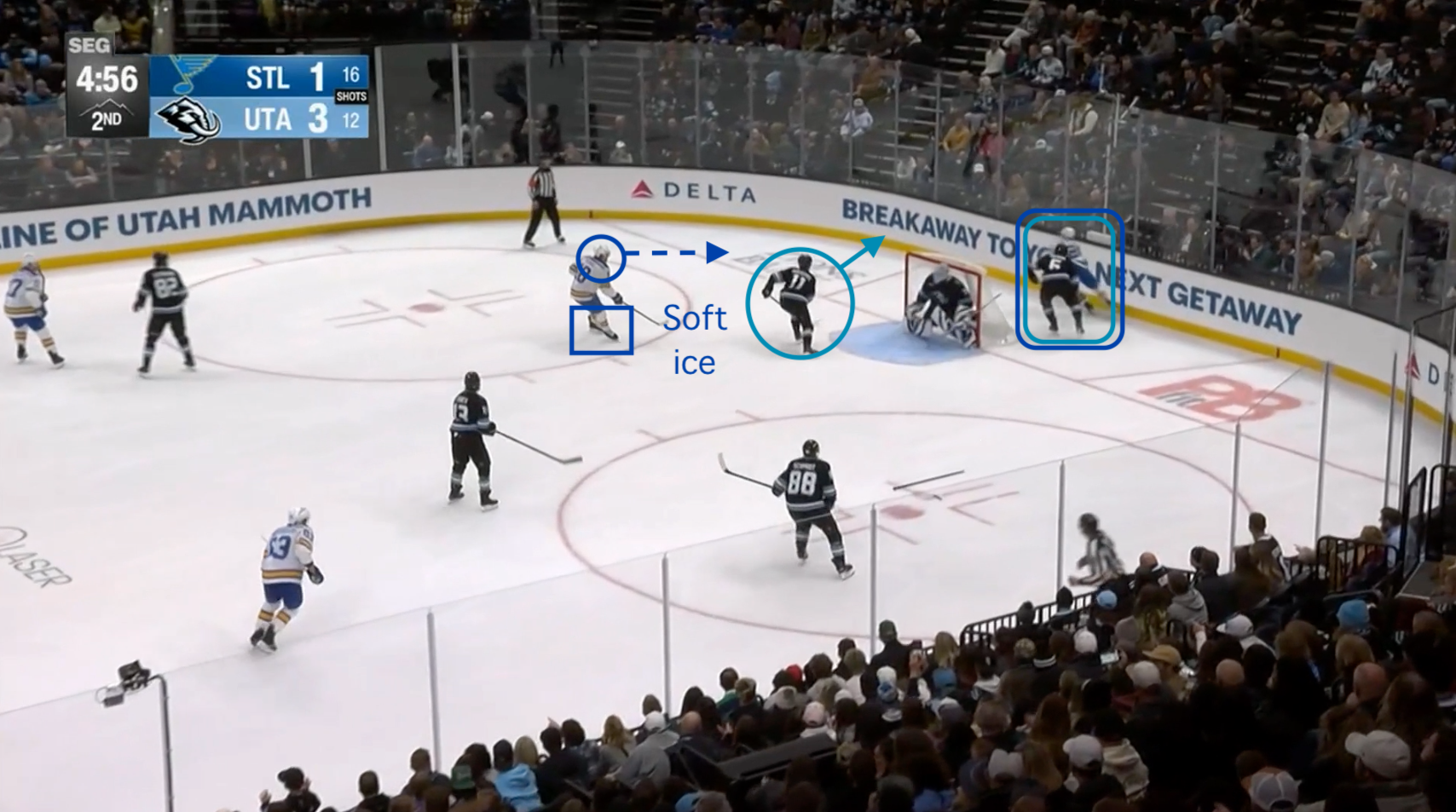
Why? Kyrou secures a clean pickup. Consequently, Thomas cuts his support route short and primes himself for a close-range feed while Guenther marches forward into an awkward in-between.
With two Mammoth defenders committed to Kyrou, a pass to the goalmouth would put Utah in serious trouble:
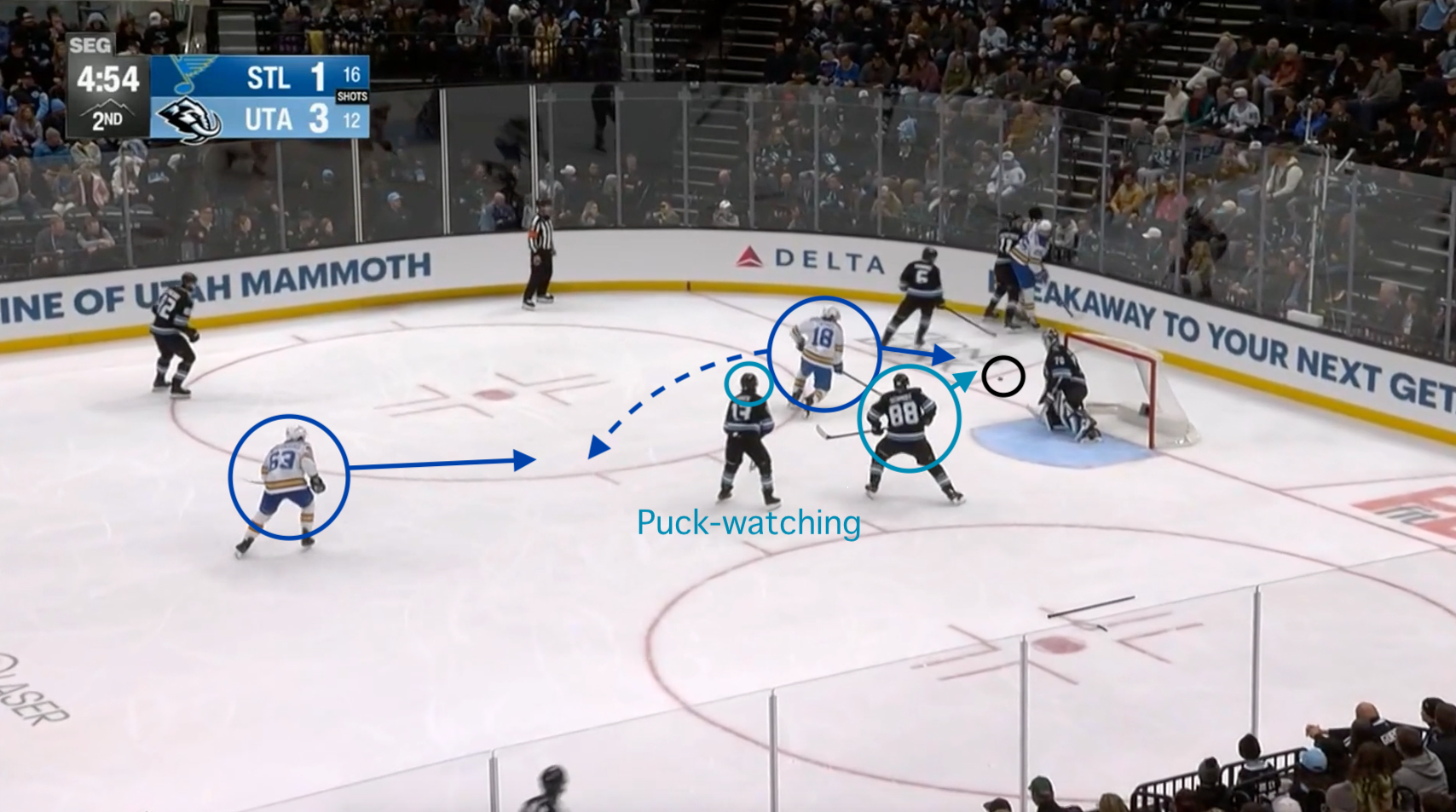
Thankfully for Andre Tourigny’s club, Kyrou’s dish lacks the juice to reach Thomas in time to capitalize. The puck barely crosses the goal line and the pivot must race Nate Schmidt (UTA 88) for the next touch. Even with the LD raring to engage, the majority of forwards would aim to pull this forehand and test the goaltender in tight. What else can you do under that kind of heat?
Thomas doesn’t believe a lower-quality bid is worth it. His proximity to the crease, meanwhile, increases the odds of the weak-side forward (Brandon Tanev, UTA 13) puck-watching just in case. That rolls out the red carpet for F3 Jake Neighbours (STL 63):
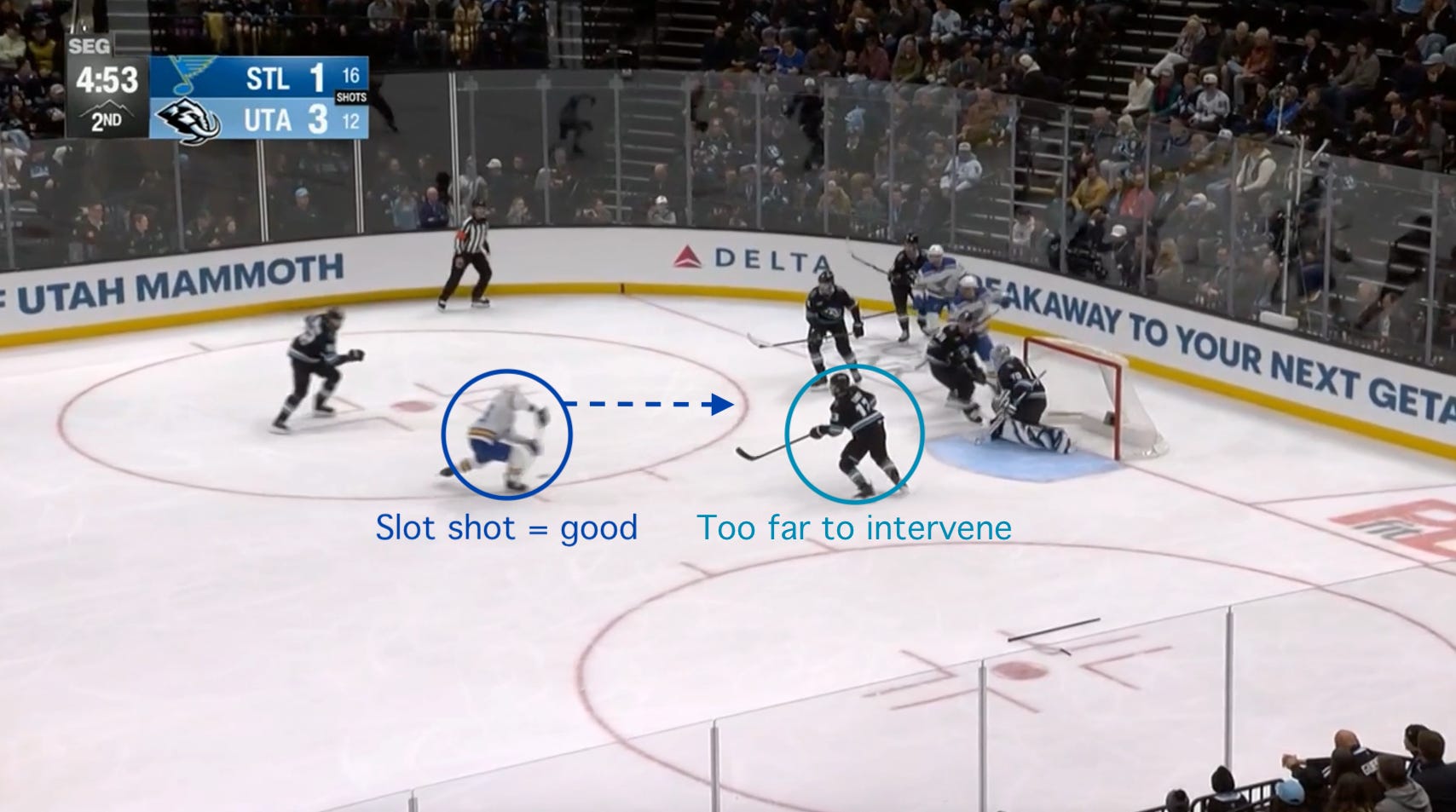
First touch draws Schmidt’s stick check —> no-look backhand pass on the tape:
Thomas’ passes frequently stem from controlled sequences, but that’s down to both the player and his targets. Flanked by craftier wingers, there’s no reason he can’t add a dose of creativity to his clinical playmaking.
Insiders have reported Carolina as a suitor. It’s an intriguing fit to be sure. With all due respect to his Blues teammates and Sebastian Aho, there’s a different level of passer-finisher potency here. Imagine him working alongside a forward like Seth Jarvis whose OZ spacing is flourishing this season. Or mid-range monster Andrei Svechnikov (97th percentile in shots from that distance). Logan Stankoven and/or Jackson Blake wouldn’t mind an uptick in service either.
What about Nikolaj Ehlers? The Dane’s high-octane dual threat next to the Canadian’s pinpoint accuracy and one-touch ingenuity could trigger mass defensive confusion—not to mention a volume boost for the center. That’s significant for a player who refuses to shoot until Grade A status is achieved:
Joining Rod Brind’Amour’s troops (1st in CF% by a mile) would introduce Thomas to a quantity of touches he couldn’t fathom at the moment. That’s one way to rebound from his underwhelming campaign (33 points in 42 games).
Ultimately, a bump in the goal department would be gravy. His offensive impact remains anchored in his playmaking because the three-time 55-assist man is as natural a passer as you’ll find in the NHL. He has the production to show for it too, ranking sixth in assist rate over the past three seasons:
I singled out the Canes because they might be the organization most desperate for a postseason breakthrough (and a top-six center). Seven straight playoff appearances. Three ECF series losses. Acquiring a 26-year-old star at a position of need might finally change their fortunes. But let’s say they balk at the Blues’ demands. There are other interesting matches around the league:
Minnesota could build a fearsome top six around Thomas-Kaprizov and Eriksson Ek-Boldy duos.
L.A.’s post-Kopitar succession plan would look a lot brighter with Thomas and Byfield patrolling the middle of the ice.
Does Detroit go all in to lock down its first playoff berth in a decade? If so, a Thomas-Larkin 1-2 punch sounds nice.
Hell, maybe Montreal believes Thomas is the perfect long-term center for Demidov and Slafkovsky.
Assuming he really is available, this is the piece that teams should be drooling over. A savvy plug-and-play center who can take care of business at the faceoff circle (52.3%), connect the dots at EV, defend and serve up dimes with the best of them. His PP contributions would grow in a new environment as well.
And since contenders represent the likeliest destinations, they’d be sliding a 1C into their 1B/2C slot. We call that winning the trade deadline.
Given the value detailed above…why exactly would the Blues move Thomas?
A good retool doesn’t begin with dispatching a star in his prime on a sweetheart deal ($8.125M AAV through 2030-31) for inferior roster pieces and futures. A rebuild, on the other hand, seems odd after successful offer-sheet gambles on Philip Broberg (24) and Dylan Holloway (24). Their most enticing veteran talent (including Thomas) has trade protection as well. They probably can’t command the packages they’re envisioning.
Buyers don’t care about the why, though. Only what it’ll cost them. The biggest fish in their pipeline (e.g. Jesper Wallstedt, Alexander Nikishin) for a leg up on the competition.