
Trade Bait: Dylan Larkin
Center of attention

Dylan Larkin’s first taste of the mountaintop at the 2026 Winter Olympics may have turned the Red Wings’ latest second-half meltdown into the last straw. Though Detroit’s captain has played a role in the club’s extended playoff drought, a 10-year absence became too much for him to bear.
The 2014 first-rounder is so desperate for a crack at the Cup that he reportedly requested a trade away from his hometown team.
As we wait for Steve Yzerman to manufacture a palatable deal—which should be possible given Larkin’s five seasons of term at $8.7 million AAV—let’s take a look at how he can assist his next team’s playoff push.
Offense
Larkin has paced for 77 points per 82 games since 2021-22 (36th among forwards). That paints the picture of a relatively high-end talent. In truth, his production outstrips his puck skills. Neither a playmaking wizard nor a deadly sniper, the 29-year-old dots the scoresheet through brute-force transition play and educated medium-range spacing.
He attacks in blinding bursts rather than sustained waves:
Best known for his straight-line speed, Larkin has slowed down some in recent years due to nagging lower-body injuries:
Nevertheless, Detroit’s captain—for now—remains well above average in most skating metrics. When you combine his raw velocity with effortless mechanics as well as a 6’1”, 204-pound frame, you get a player who can still take the top off defenses on a regular basis.
Separation comes naturally to him, and the ease with which he achieves it allows his team to capitalize on the faintest windows in transition. Much like elite slot receivers can turn slants into splash plays, his length and puck-carrying vision/confidence can convert give-and-gos, soft area passes and loose pucks into jailbreak rushes.
It’s not always pretty. He has to muscle through obstacles at times, but he does well to lug the puck at the end of his range and time his underhandles (stick off puck) in order to preserve possession through check attempts. This is a player who holds the puck ever-beyond your grasp.
That blend of pace and posture means you can’t stall out or slip up against him in the NZ. Otherwise, he’ll race past your blockade in search of direct offense:
Even without his electrifying burst from 2021-22, he dusted defenders left and right last season. His decision-making occasionally fails him, though, so teams would be wise to grant him slightly later touches vs. thinner defensive ranks. Have him generate momentum as a pass recipient to facilitate instead of orchestrate zone entries himself. Tracing a cleaner line from point A to B will let him hustle and shoot instead of scanning and slicing.
Maintaining tempo becomes a trickier proposition in the OZ. Larkin lacks Nathan MacKinnon’s stop-and-start explosiveness or Aleksander Barkov’s palm-on-your-forehead wingspan, so his finest moments usually occur off puck:
Larkin is more of a toolsy player than a brainy one. However, he does display sharp play recognition as a trigger man. Thanks to his anticipation and understanding of offensive progressions and leverage, he frequently makes himself available in mid-range.
It’s as though he can see the ice from the passer’s POV and positions himself accordingly. Quite a useful trait to slot alongside a top-tier distributor. GMs should keep that in mind to extract full value from their trade.
Here’s an example of his savvy spacing on the PP:
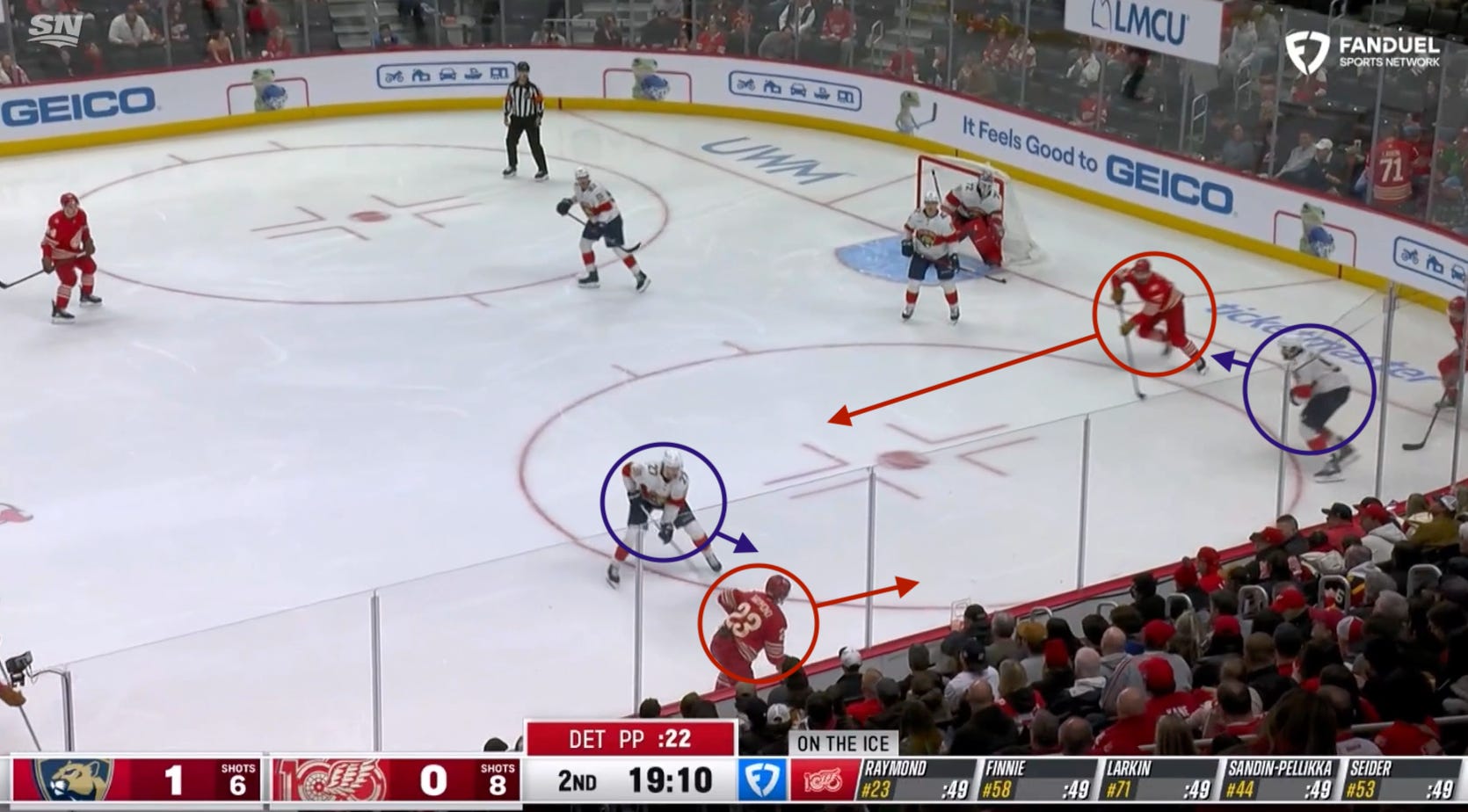
Strong-side PK forward Eetu Luostarinen (FLA 27) applies heat on Lucas Raymond (DET 23) along the half-wall, using his 6’3”, 191-pound build to hurry the Swede and his trailing stick placement to deny the PP its plainest path to middle ice (point man).
Sensing that his winger requires an outlet, Larkin climbs from the goal line to the near hashes:
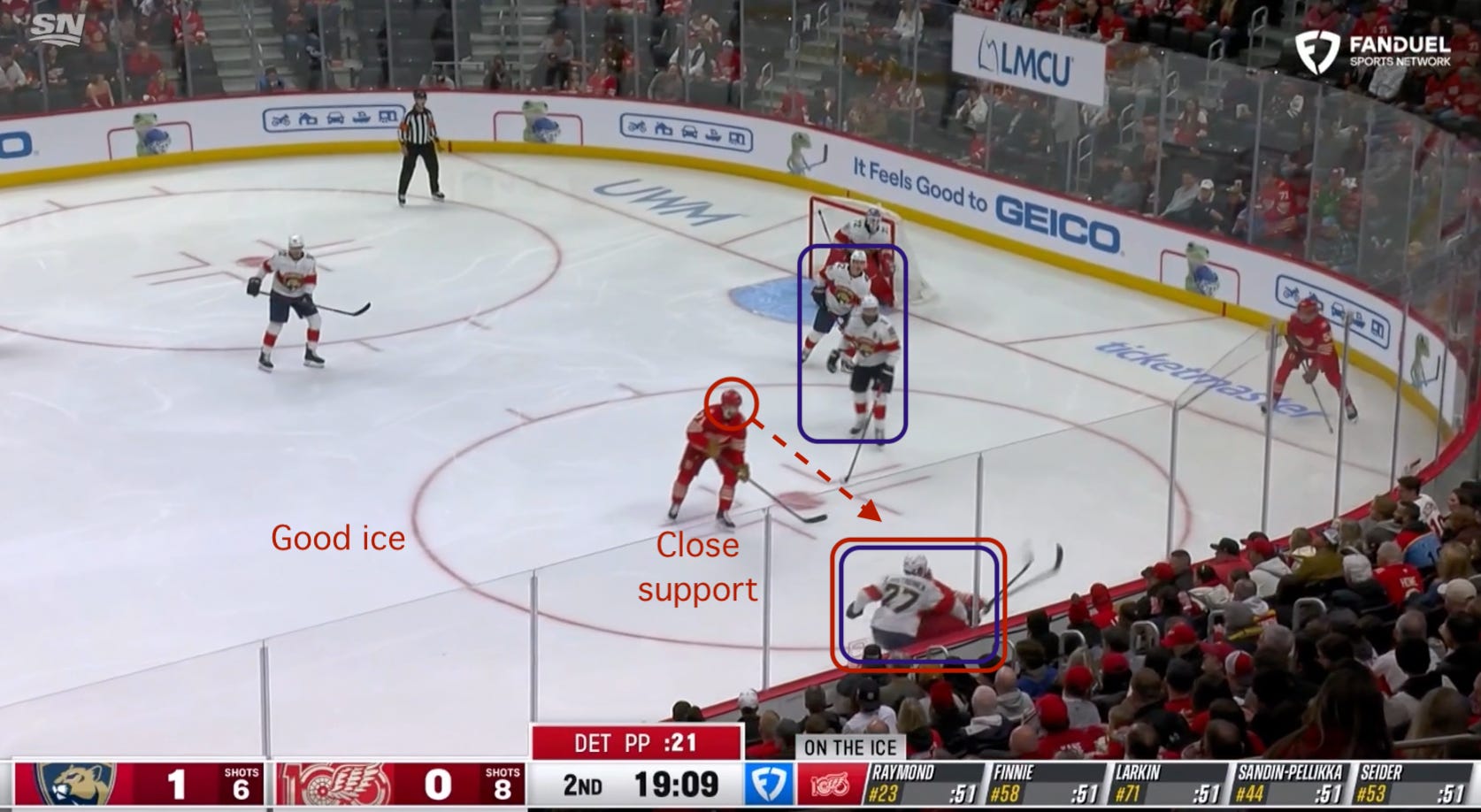
Standard tight support from your center. Raymond is able to maintain control through contact, though, which opens the door for Larkin to upgrade the incoming pass from a supportive to a scoring touch:
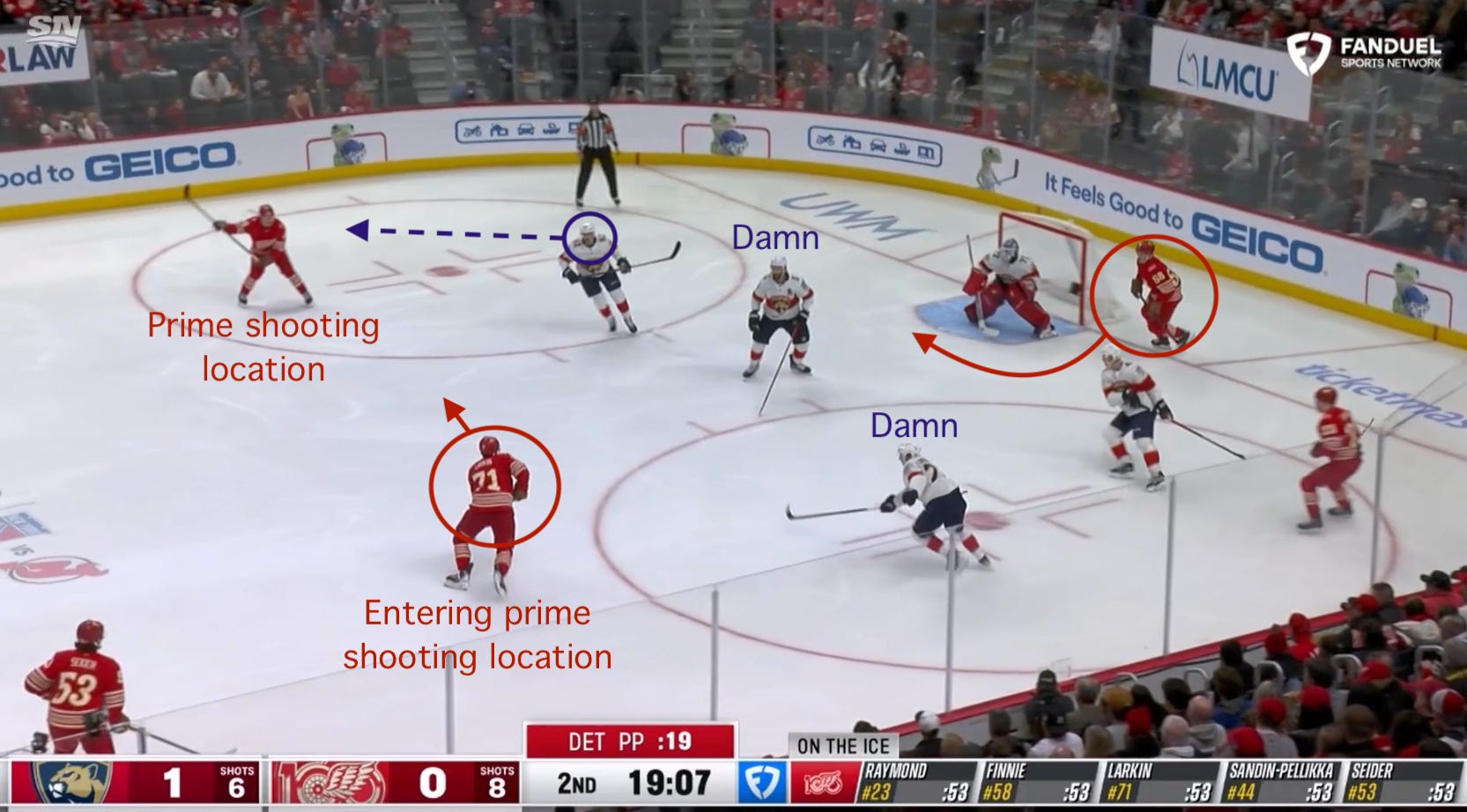
Whereas your average forward might have parked in the circle and waited for Raymond to cook, the U.S. Olympian fades to the high slot to enhance the danger of his catch and escape both Luostarinen and Aaron Ekblad’s (FLA 5) stick-checking radius. With Axel Sandin-Pellikka (DET 44) cocked, ready and drawing the attention of weak-side forward Tomas Nosek (FLA 92), the center now has an uncontested path to the heart of the OZ.
Skating to that location also affords Emmitt Finnie (DET 58) the time to affect Sergei Bobrovsky’s (FLA 72) sight line.
DET’s PP only falls short because, again, Larkin isn’t a clinical shooter:
Many setup men would be delighted by his off-puck reads all the same. ~30 goals remains his likely threshold, but 35+ isn’t off the table in a 1C role next to a game-breaking passer. He just knows how to put himself in plus situations.
Another area of strength in the OZ is his gift for winning puck battles. This isn’t sexy at first blush, but it grants his linemates a number of extra touches. Should you pair him with a top-flight winger (e.g. Kirill Kaprizov or Mitch Marner), the value of those pucks will skyrocket. Watch him prevail in duel after duel:
There’s a heaviness to Larkin’s game that belies his speedy-shooty boi label. He’s eager to stick his mug straight in the fire. Better yet, he exhibits an innate feel for body orientation/leverage, claiming position before possession on loose puck retrievals and throwing center mass in your way to seal the wall. Very few star pivots—if he qualifies as such—deploy their body as willingly or effectively in the trenches.
His linemates’ faith in his grunt work informs their choices too. These aren’t 50/50s for him. Operating under the assumption that he’ll emerge with the puck when the dust settles, they can chart a NZ course or sneak away from the OZ pile with greater conviction. Get the jump on defenders —> profit.
Make no mistake: He has his flaws. In fact, his are perhaps more pronounced than those of his fellow top-six centermen.
Despite his hard-nosed dimension, his net-front play is surprisingly…limp:
At 5-on-5 (his HD volume spikes on the PP), gaining depth isn’t the problem. He simply doesn’t DO much around home plate. He doesn’t jostle with defenders to hinder the goaltender’s vision or reset his station when his teammates shift the point of attack. He doesn’t travel the hard road. He stands in one spot and prays for the action to reach his doorstep.
That, in addition to his dubious shot selection, causes the vast majority of his EV expected goals to originate from lower-danger quadrants:
Maybe a change of scenery juices his wheels and close-range hunger. Maybe he uncovers so many tap-in opportunities that his lackluster traffic doesn’t matter in the end. But if you’re pegging him as your second line’s engine (i.e. a scenario in which he might not receive gift-wrapped Grade A chances), for example, you’d like busier net-front activity in the absence of pure marksmanship.
Then there’s his passing.
I alluded to this earlier, and it’s worth fleshing out. While the “star two-way grinder” template might have you envisioning a Mike Richards type, Larkin doesn’t boast the retired center’s IQ or finesse. As a playmaker, he’ll often tunnel-vision on one option and try to hammer passes to their destination. That works when his team has an advantage of some sort. Force him to stop up and scan from a level playing field, and he’s liable to fling hopeless Hail Marys:
Yeah, there are distinct blemishes in his game. They’re trumped by his undeniably enticing attributes. He’s a machine in transition. He provides stellar OZ targets. He’s stouter than most top-six centers in 50/50 battles. And he’s consistent in those departments, which has yielded consistent numbers:
Peep those lines. There’s hardly any variance in his year-over-year individual numbers since 2021-22. That speaks to the heart of his appeal in this summer’s market. Unlike with, say, Trevor Zegras, Dylan Cozens or Pierre-Luc Dubois before him, Larkin’s game isn’t shrouded in mystery. You know precisely what you’re getting.
His fit on your squad is thus a matter of roster composition. He can’t be THE guy on a contender, but flanked by a world-class passer or tasked with 2C duty, he might be its missing piece.
Defense
Meanwhile, his reputation as a two-way center is…somewhat warranted.
Deploy him as a shutdown artist, and he’ll disappoint. Ask him to hound the puck, and he can deliver the goods as a 200-foot disruptor.
The same speed, range and jam that benefit his team on the offensive side lead to above-average defensive impact. Especially in an on-puck capacity, he can prove quite annoying to play against. As such, if you pair him with responsible off-puck wingers (e.g. Artturi Lehkonen), he could fill a matchup role:
This is a defender who casts a long shadow. Larkin’s mobility, wingspan and lane integrity add the numbers you need to defuse if not outright kill counters/rushes. That tracking will instantly enhance his club’s solidity in transition. In the DZ, he possesses impressive closing speed on would-be shooters, frequently snuffing out bids at the last moment. He’s patient when the game whittles down to mano a mano showdowns as well, focusing on containment until an attractive stick-checking angle appears.
His one-handed swipes along the boards, in particular, dispossess a steady stream of opponents:
Bearing his backchecking and recovery ability in mind, it’s difficult to shake a locked-in Larkin. Tage Thompson (BUF 72) and his Sabres teammates can attest to that much:
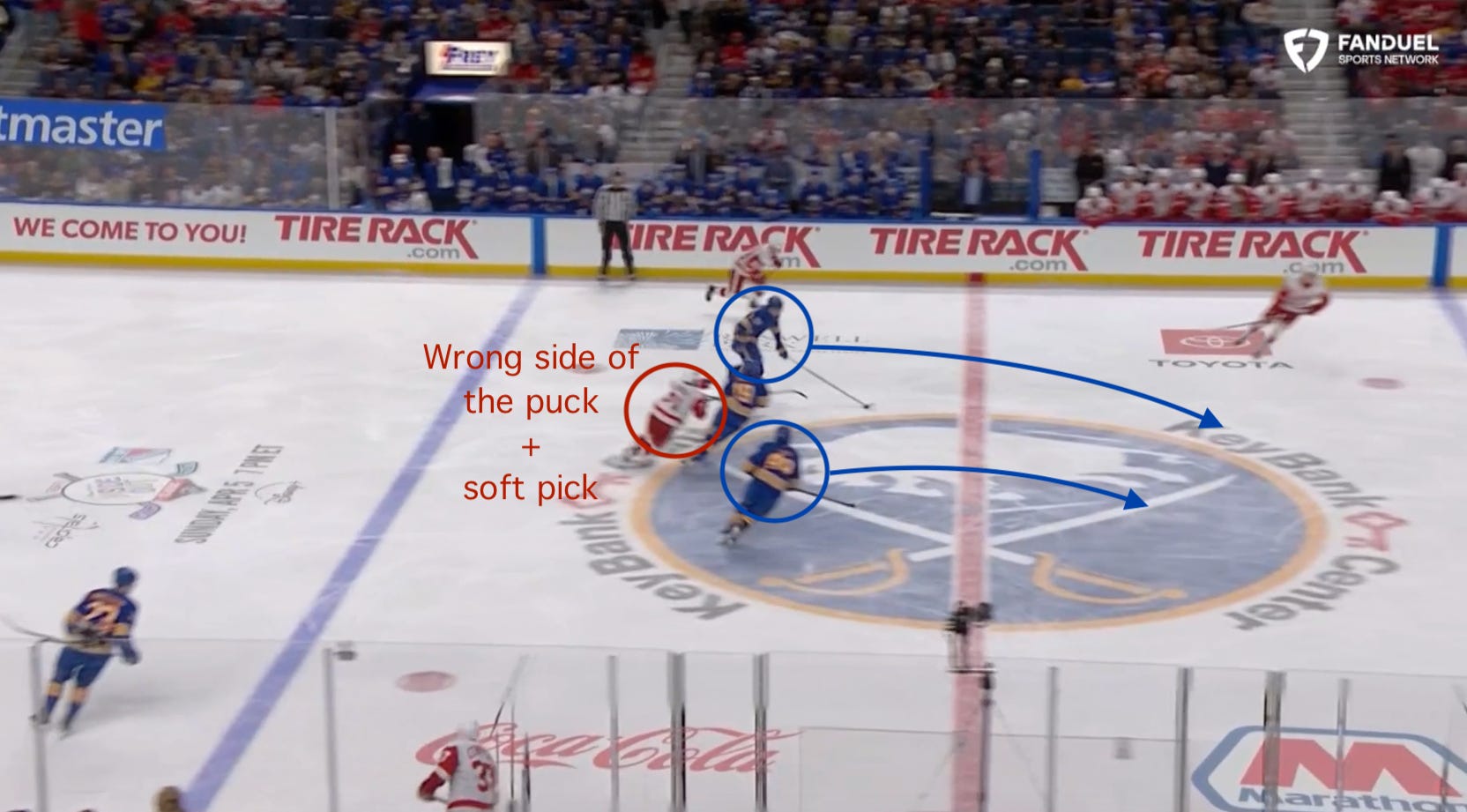
Larkin begins this NZ sequence on the wrong side of the puck with Peyton Krebs (BUF 19) preparing to set a soft pick that will spring Thompson and Alex Tuch (BUF 89) on a clear 2-on-2 vs. Moritz Seider (DET 53) and Simon Edvinsson (DET 77). This isn’t what you want to see from a two-way center.
Fortunately, he’s well equipped to correct his own missteps:
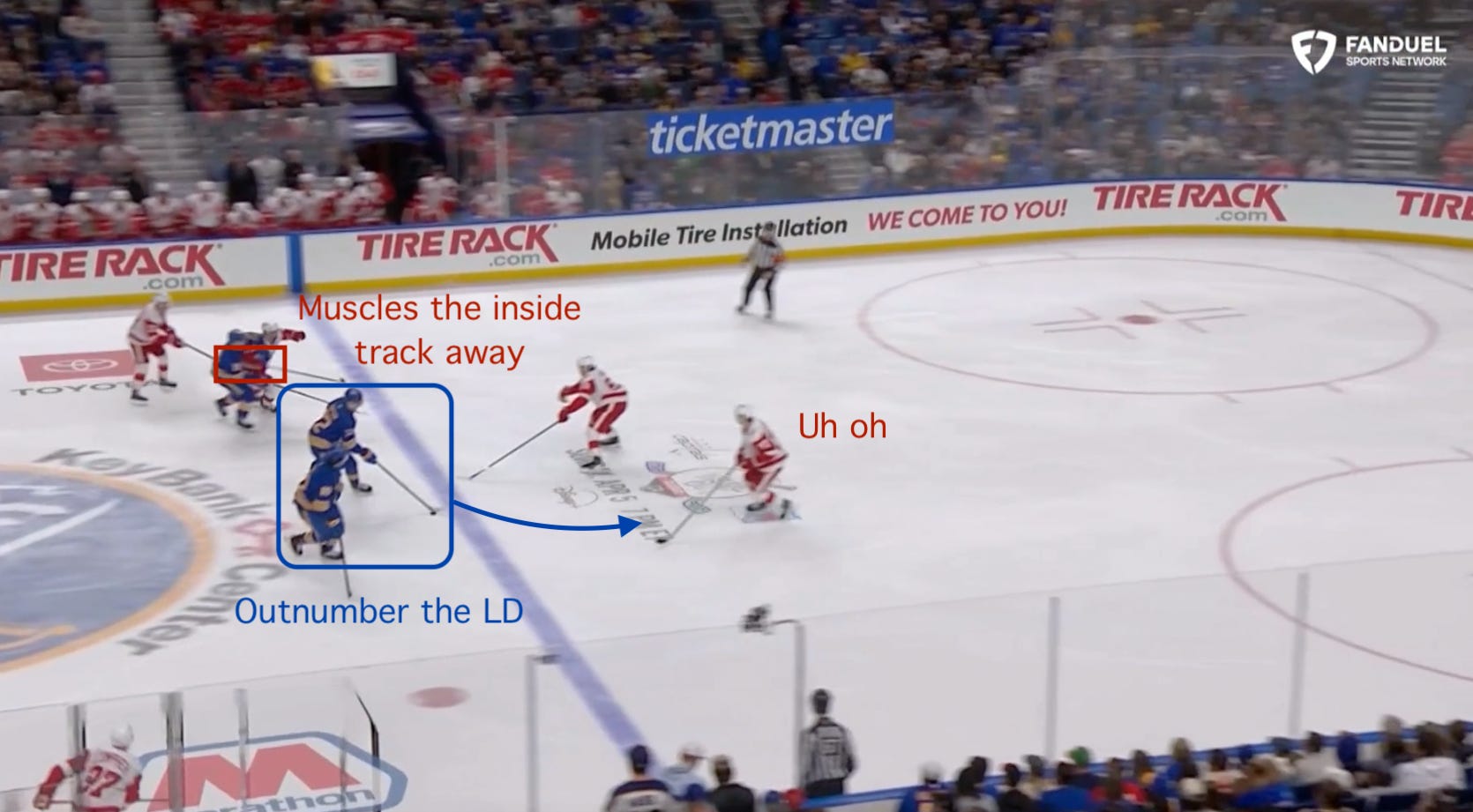
The center moves his feet to gain ground on Buffalo’s duo, yet Krebs is an excellent skater himself. Sheer speed won’t cut it. He summons those puck battle chops once more, digging his inside elbow into his counterpart’s chest to propel himself forward as Thompson and Tuch aim to out-man Edvinsson on the left side of Detroit’s back end:
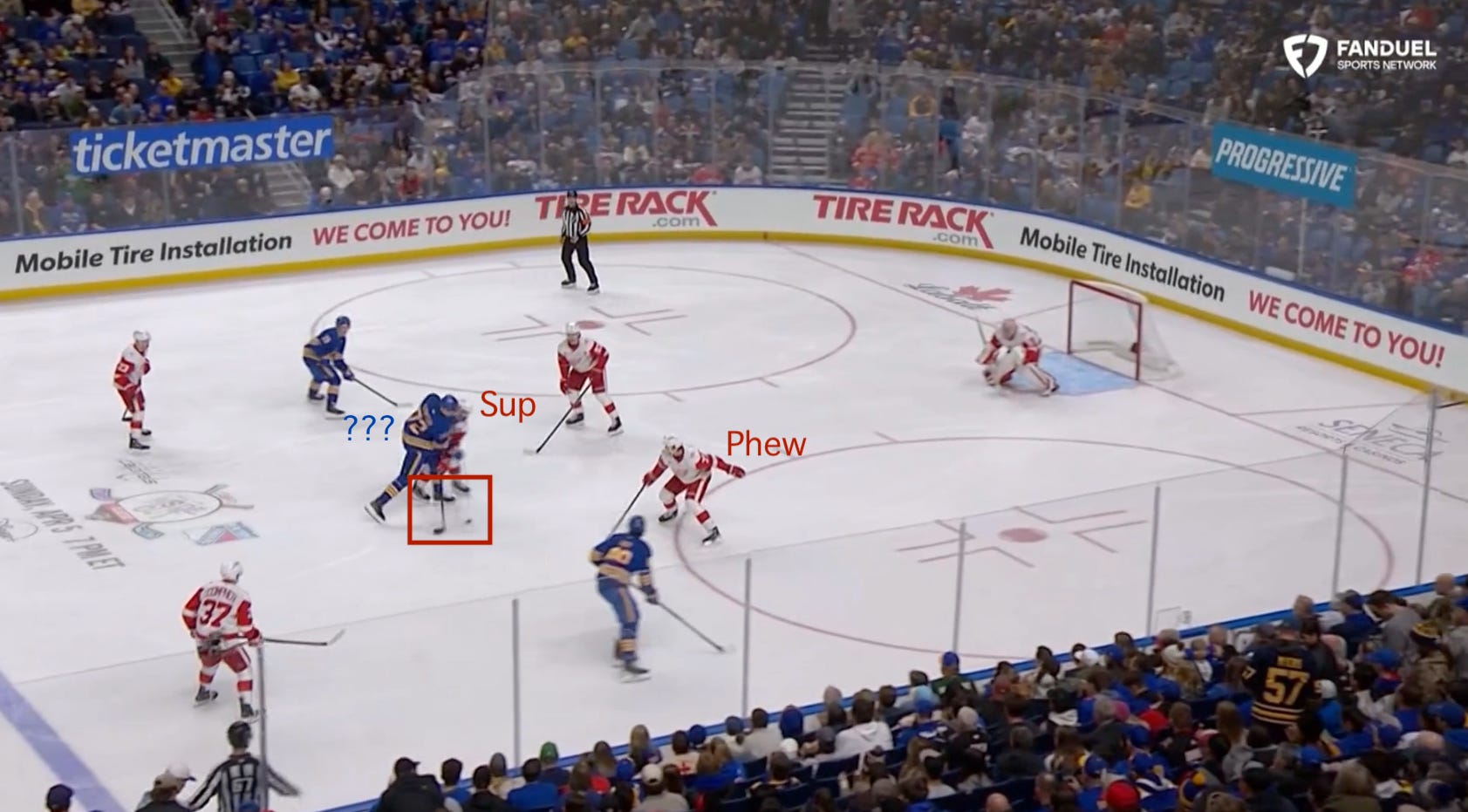
The result? Larkin roars back into the equation during Thompson’s pre-release work to crowd his platform out of nowhere:
To balance out his uptempo open-ice exploits, his in-zone defense brings sandpaper to the party. His clashes with Joel Eriksson Ek (MIN 14) in the package below reveal a pivot who prioritizes the inside track above all else in puck battles, only thinking about a recovery once he’s obtained an advantageous position. Not many forwards will wrestle that edge away from him down low.
Although he’s far from a bruiser, his insistence on defending with both his stick and body demands attackers to play through him. That’s no minor feat in the modern game.
Larkin’s under-the-radar physicality brings many OZ designs to a screeching halt:
With all that said, he’s very much an on-puck specialist. When he has to keep tabs on off-puck targets, the holes in his defense rise to the surface.
In a nutshell, his coverage is…a little rough. He puck-watches and plays with virtually no urgency unless he senses immediate danger. It’s often too late by then. In one of the clips below (0:19), Eriksson Ek—who couldn’t handle Larkin in 50/50s earlier—simply beats his sleepwalking counterpart to the spot:
Beyond the odd power-kill flurry, his PK contributions leave much to be desired as well. When the PP has time and clear possession (i.e. when pressure is a low-percentage bet), the strong-side forward’s responsibility is typically to settle into a depth that discourages a bumper/seam pass and a width that covers the near-side point man’s shooting lane. He can do the former yet flounders at the latter, not scanning with sufficient frequency to cordon off high middle ice.
In other words, his defense crumbles once the setting shifts from full-on chasing to read-and-react marking.
Granted, his usage did him no favors. Even though he’s not a true matchup center, Todd McLellan rolled him out against the opposition’s best. He logged the team’s highest share of minutes vs. elite competition last season—and by a mile:
That could explain his unsightly xGA/60 (3rd-worst among Red Wings forwards). The worrisome part is that number became positively horrific (3.00 xGA/60) when Seider (a legit shutdown defender) left the ice. How would he fare in a matchup role sans Big Mo?
Suitors that view him as a dependable two-way center should consider whether they have the elements required to conceal his blemishes. A suffocating forecheck. A bold NZ philosophy. High-end stoppers. Pretty much anything other than McLellan’s aggressive zone scheme. Larkin never found his DZ groove in 2025-26, struggling to press up on off-puck targets without letting them past him.
He’s more Macklin Celebrini than Anthony Cirelli on the defensive side of the puck. Toolsy, hard-working in pursuit, prone to lapses in coverage.
A more structured and insulated environment may highlight those first two qualifiers to such a degree that the third becomes an afterthought. Remember the discourse surrounding Seth Jones prior to his arrival in Florida?
Though far from perfect, Larkin is an established top-six pivot and the best available player at his position. You can excuse the occasional OZ and DZ shortcomings when his pacey style fortifies your standing in the most important battleground on the ice: the NZ.
His influence in that department was wasted in Detroit.
A change of scenery and clean bill of health may take the thoroughbred’s game—and his team’s performance—to a whole new plane.
3 firsts and the GM's daughters hand in marriage and a racing horse
That comp to Celebrini is the first time I’ve seen a 10+ season vet get compared to a guy just leaving his sophomore season. Very effective image, though.