
Trade Bait: Adam Fox
The RD pipe dream

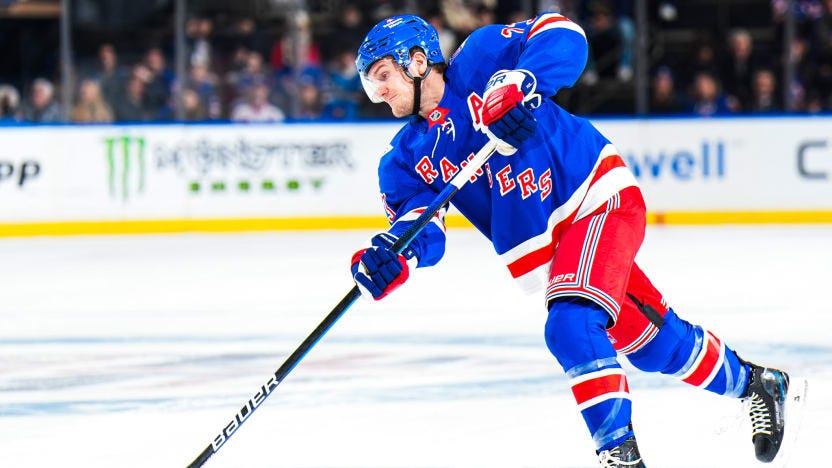
In mid-January, Rangers general manager Chris Drury promised the fanbase a retool. He’s certainly stayed true to his word:
OUT: Artemi Panarin, Vincent Trocheck, Sam Carrick, Will Borgen, Conor Sheary, Adam Edstrom, Johnny Brodzinski, Brett Berard
IN: Pavel Dorofeyev, Marcus Pettersson, Oliver Bjorkstrand, Sean Durzi, Joe Veleno, Joonas Korpisalo, futures
The Blueshirts will, at the very least, feel different in 2026-27. Is that enough to appease their best player? Adam Fox’s late-season, noncommittal comments about his future were…concerning.
I’m not suggesting a trade is imminent or even likely, but if he isn’t sold on New York’s direction by, say, Thanksgiving, he could become the latest American star to strong-arm his way to greener pastures. Here’s why teams leaguewide should be monitoring this situation with bated breath.
Offense
Fox is the smallest (5’11”, 185 lbs) and weakest player on the ice 90% of the time. He’s never crossed the 22 mph threshold since the NHL started tracking skating data either. This is a slight RD who’s slow as molasses. In spite of these shortcomings, the 28-year-old has established himself as one of the most productive blueliners on the planet:
How has he kept pace with peers who are faster than him, taller than him or both?
His IQ. Plain and simple. The rearguard is often cited as the league’s smartest player, and…I don’t have a hot take for you. Divvy up his decisions into good vs. bad buckets (talk about a time-intensive hockey sense project), and the former would spill over before the latter saw more than a few drops. He sets the table for his teammates over and over again without compromising their structure, and that creativity-efficiency brew amounts to the heartbeat of New York’s offense.
Better yet, despite appearing in just 55 games, 2025-26 was the freshest Fox had looked in quite some time. He finally shook off the knee injury that hamstrung him for ~2 years to announce that he remains THAT guy:
As with most top producers on the back end, the story begins in transition. Fox’s lousy speed prevents him from skating himself out of a bind, so he has to harness other attributes to generate positive momentum in the NZ. His timing, accuracy and deception make him one of the league’s finest breakout passers.
In addition to exhibiting steely patience, his curious hunched-over forehand posture suggests he could strike at any given moment. No puck-handling fluff or thought of grabbing the reins himself. Once he has possession in his hip pocket, his finger’s on the trigger. The tension underpinning these loaded-stance touches bewilders opponents on a nightly basis:
They anticipate the early bird. What confronts them instead is a puck-mover who plays chicken with forecheckers, hanging on a tick longer than conventional wisdom would recommend in order to capitalize on F1’s belief that token pressure will force the puck out of his hands. Once they overrun their angle, Fox can split the first two men in with ease. His talent for slow-playing opponents also sows confusion in F3 on stretch passes. Much like their teammates, they’re relying on the play to progress at a normal tempo. Fox’s off-schedule rhythm throws the entire forecheck for a loop. F3 frequently peers back wondering how the D-man is still cradling the biscuit, blowing their lane integrity in the process.
On NZ breakups or reloads, his read on the game’s pulse takes precedence over trickery. He displays an innate feel for slipping pucks past the pile to manufacture velocity as well as numerical advantages for his forwards. His throttle control—understanding when to lay on/off the gas—is outstanding.
You’ll notice that many of the feeds above slice straight through the heart of the rink. This is where his foremost wart becomes a blessing in disguise. High-end skaters can evade F1s without any issues, but they’re eventually guided wide on most touches. Fox’s need to orchestrate from a distance has taught him the art of guile. His eyes and body language nudge defenses off balance. There’s no positional certainty, and without their NZ funnel, they’re spaced out and unable to clamp down on his middle-ice setups and side switches.
Plus touches for days.
We haven’t even hit the OZ yet. Stray a couple of feet too far in coverage, and he’ll carve you apart in a flash. What’s more, he doesn’t get sucked into trying to play hero. Here’s an example in which he identifies Jack Hughes (NJ 86) as the Devils’ weak link, flings a seam pass to knock down the first domino and comes away with a secondary assist:
As the puck rolls up to the right point, Hughes inches above his assignment (Mika Zibanejad, NYR 93).
Although Fox could buy time in hopes that his center wriggles free down low, he knows that switching sides ASAP will reveal the extent to which Hughes has lost inside leverage on the Swede.
Rocket seam pass —> Gabe Perreault (NYR 94) spots the net drive —> tap-in.
What separates him from the pack, however, is his composure at the point. Whereas Makar, Hughes, Werenski, Dahlin and Hutson can dance their way downhill should a quick-strike opportunity fail to present itself, Fox largely plies his trade in first gear at the blue line—and he’s sensational in that area:
His knack for outwaiting the opposition grows stronger still in the OZ. Defenders don’t expect extended touches in tight quarters, and in a league that mostly plays man coverage above the circles, that spells trouble. Watch him repeatedly lure the strong-side forward higher while dragging the weak-side marker lower, supplying his LD with ages to assess his options. Should your stick work waver in more dangerous locations, he’ll upgrade from timely D-to-Ds to surgical high-slot/royal road passes.
His recipients always enjoy an edge (large cushion, inside track, etc.) over the nearest opponent. Through distribution alone, he’s a certified space multiplier.
Here’s another clip that illustrates the details in his decision-making:
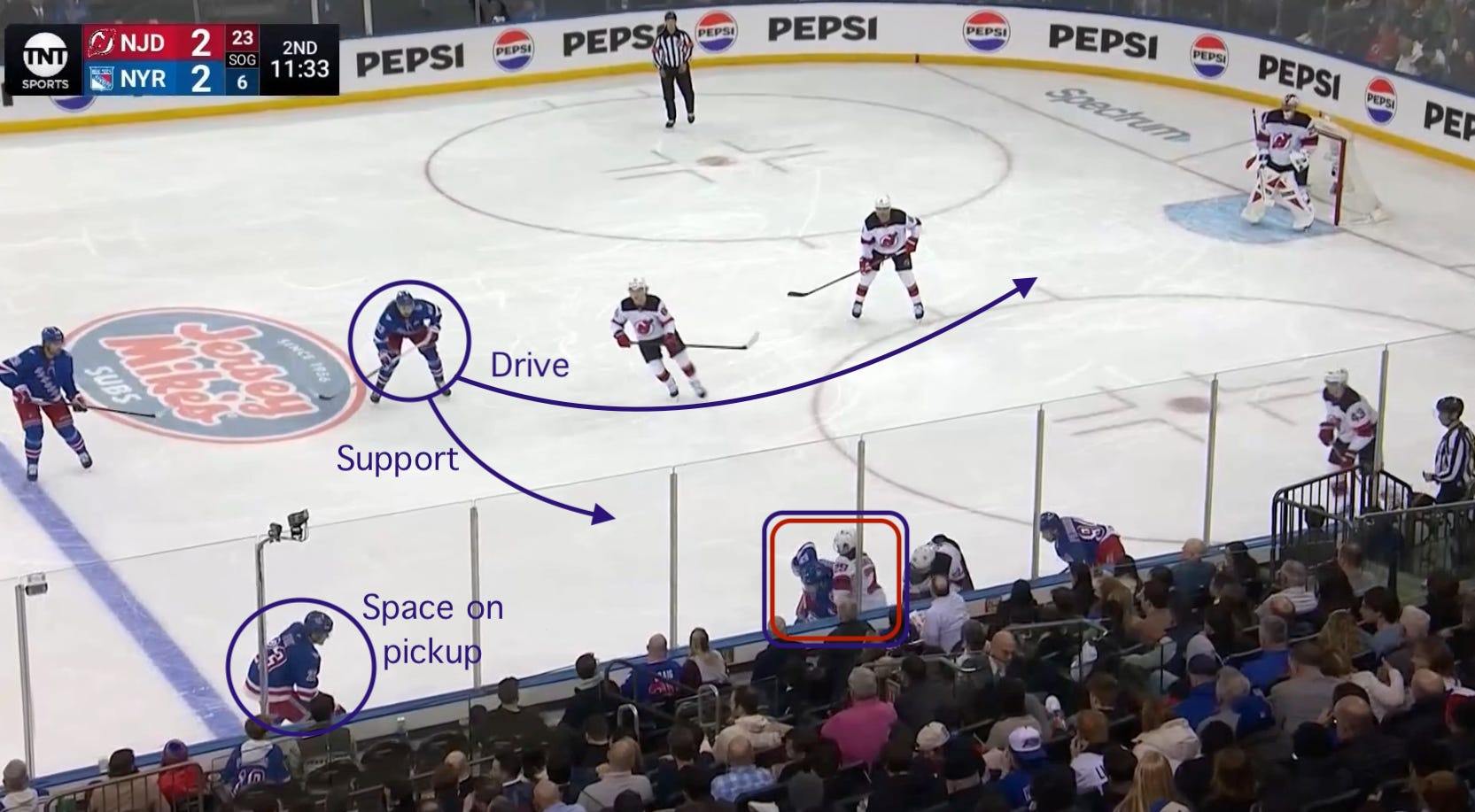
Four players duke it out for possession on the boards. Since Alexis Lafreniere (NYR 13) has Lenni Hameenaho (NJ 29) sealed off and Zibanejad is contemplating puck support, Fox joining in would result in too many cooks in the kitchen. A recovery amid this congestion, with no teammates in medium- or high-danger territory, would require him to skate clear of Cody Glass (NJ 12) before thinking offense.
Posting up at the blue line, on the other hand, gives him the green light to attack middle ice as soon as he snatches the puck (while Zibanejad can switch to driver). Sure enough, New Jersey inadvertently knocks it to him:
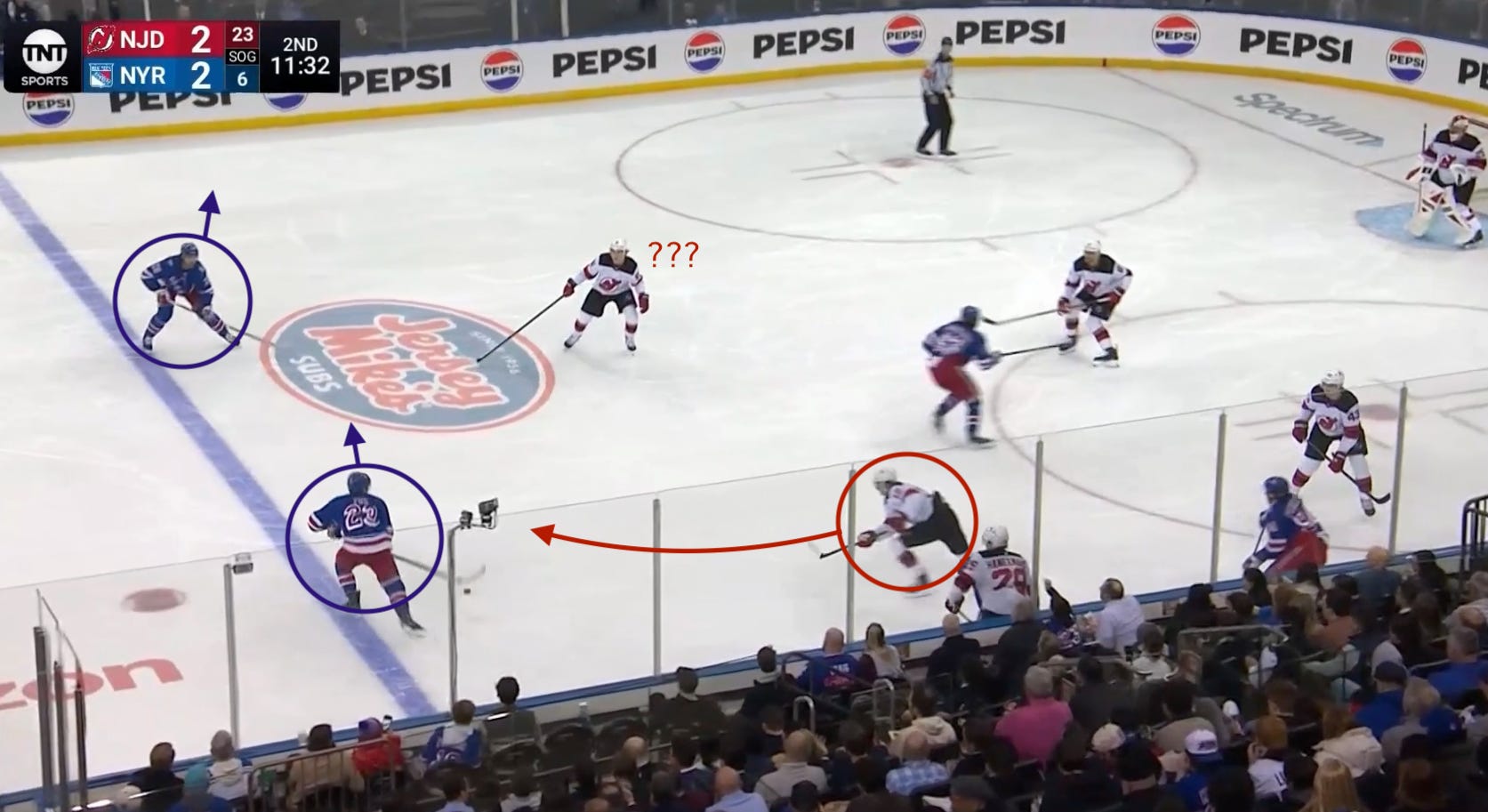
Thanks to his spacing, he has a massive head start on Glass as he creeps inside. This becomes a temporary 2-on-1 at the point, and weak-side forward Arseny Gritsyuk (NJ 81) is…sweating bullets. He doesn’t want to concede a lateral pass to the LD (Matthew Robertson, NYR 29), but sagging off a world-class defenseman seems wrong as well.
So he ends up hedging.
Not ideal vs. a choice setup man. On top of that, holding your stick this far ahead of your frame when you’re parked beyond checking range is just begging the RD to exploit your triangle:
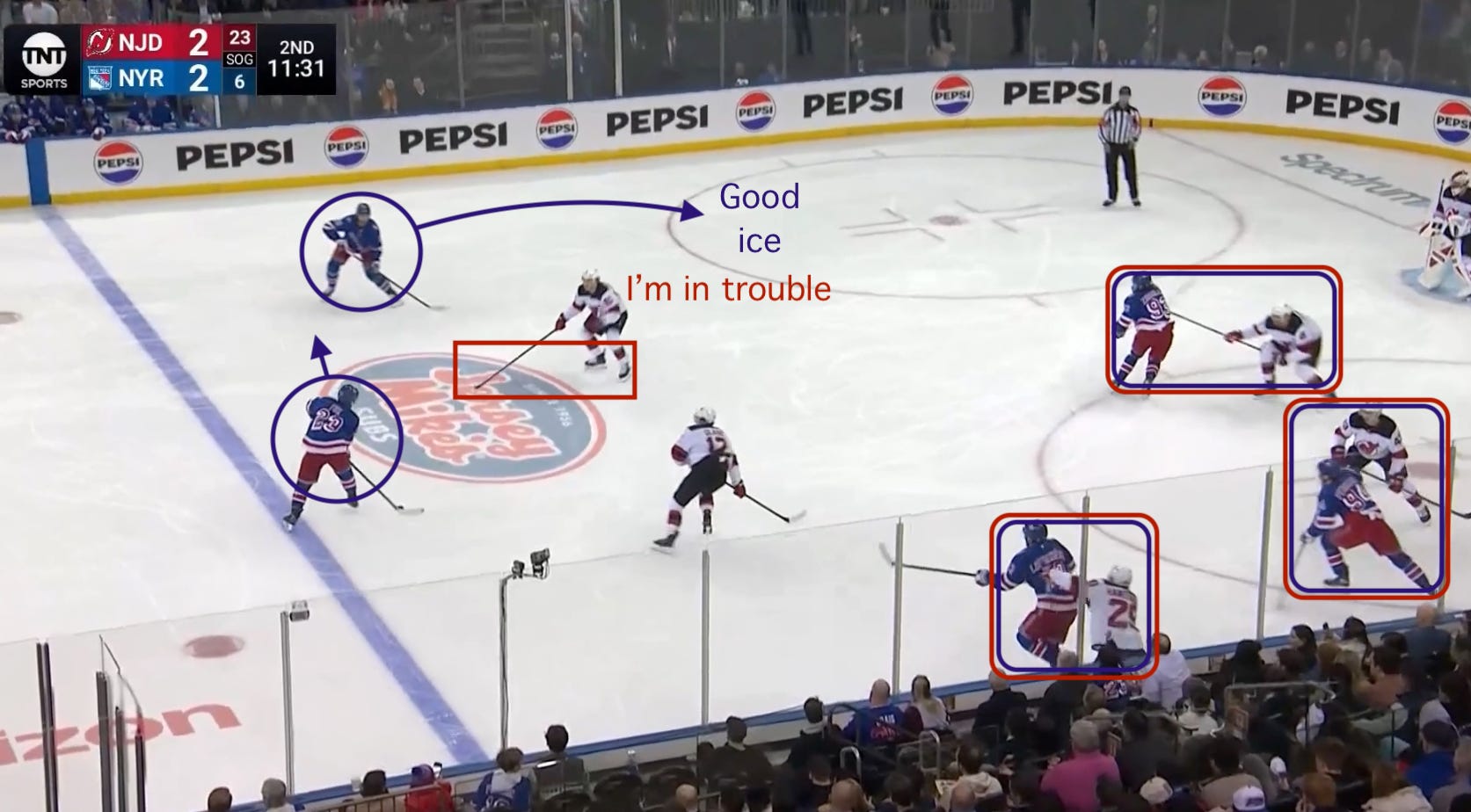
It gets worse for New Jersey.
With his partner squeezing him to the wall, Robertson recognizes that there’s no longer any value in widening out. Fox’s path is asking him to push vertically, and he obliges. The RD threads the needle and the LD slides to the left dot as Zibanejad and Johnathan Kovacevic (NJ 8) occupy Jacob Markstrom’s (NJ 25) sight line:
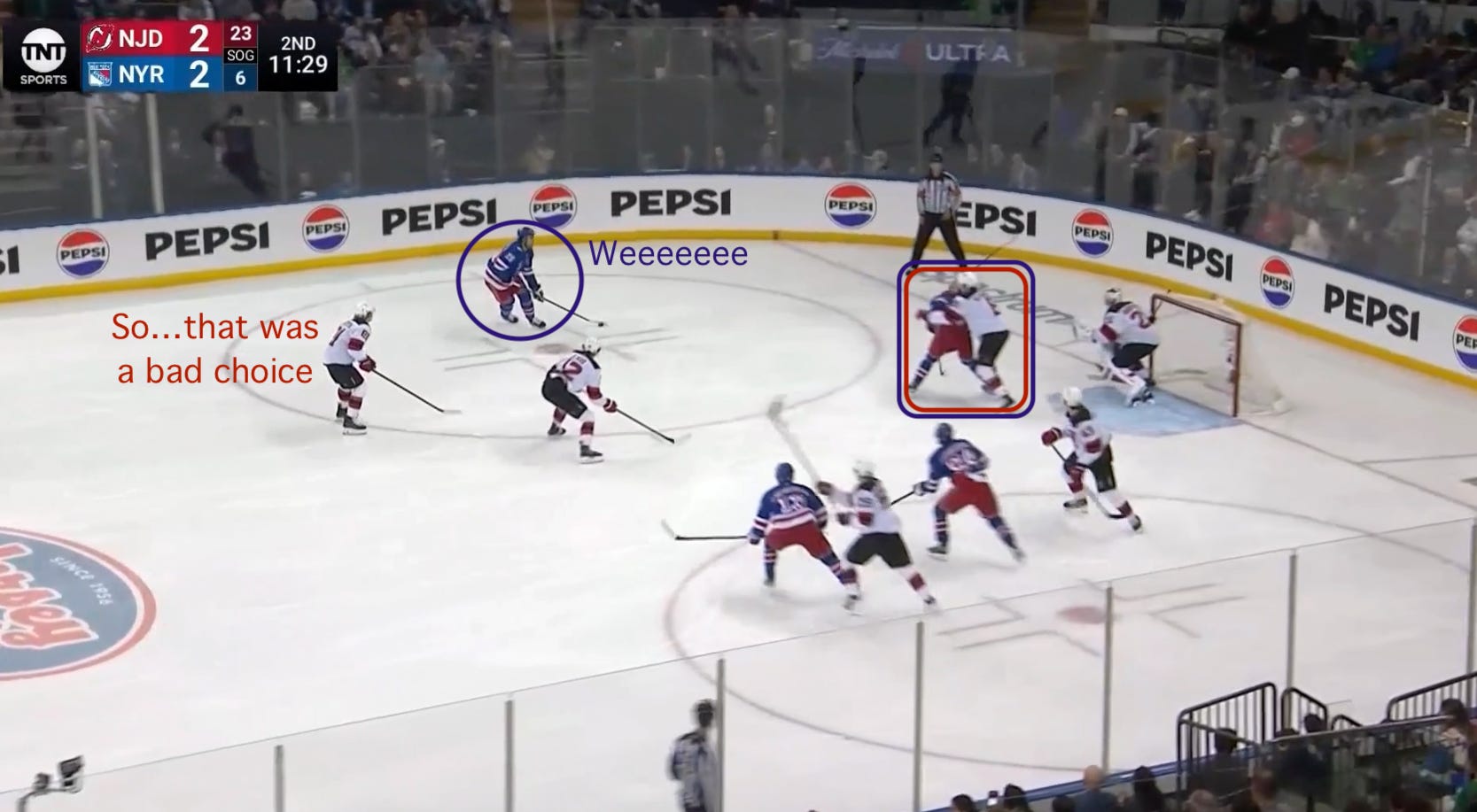
Ordinary point pickup + Fox’s optimized puck-moving arsenal = slot opportunity:
Now, none of this snowballs without the threat of a shot. Were Fox reluctant to fire from high middle ice, the math for Gritsyuk would completely change. He’d trail Robertson and let Glass close the gap himself. Alas, the Rangers’ 1D happens to be one of the cagiest point shooters in the sport.
Following the Quinn Hughes blockbuster last winter, I crowned Minny’s centerpiece as the best in the league at shooting for traffic. That’s true, but strictly on account of Hughes’ gift for solo separation. He can conjure more daylight and consequently more volume than any defenseman around. If we limit the scope of this discussion to shot selection and shot trajectory, Fox takes the cake.
He essentially lobs alley-oops to his forwards:
Trocheck (NYR 16) can confirm the tippability of Fox’s wristers. They consistently bypass the first defender, they’re launched directly at whichever side you’re holding leverage and they flutter a few feet off the ice to maximize the chances of a meaningful redirection. The RD’s offerings from the point would elevate any offense that floods the goalmouth.
There’s one final piece to the offensive puzzle:
Fox thrives at play extension along the wall and adjusts his tack depending on his counterpart’s cushion. On contested touches, his razor-sharp timing and bead on the puck help him jar it loose. Draped over the retriever, he’ll secure an airtight board seal while his stick prowls a few feet to the side to dilate his footprint. When he’s a tick late, he’ll feign pressure, release back to the point and call on his hand-eye coordination to repel the opposition’s strong-side chips.
In addition to those keep-ins, he’s crafty on pickups. His vision locates available link-ups under pressure, his body language baits a defensive commitment in one direction or another and his touch enables recipients to walk straight into their next move. When he’s out there, the Rangers can weather the heat and cut against the grain with room to spare.
Now put all of those advantages together:
NZ targets enjoy time, space and speed with which to hatch their plan.
Open teammates don’t have to wait long for A+ service in the OZ.
If you aren’t open, he can manipulate defenses into forgetting you exist.
He deposits point shots neatly into your net-front wheelhouse.
His keep-ins and link-ups generate possession out of 50/50 scenarios.
Not much of it is flashy, yet very few—if any—blueliners grease the wheels of their team’s attack as effectively or comprehensively. That command over the action is reflected in the numbers too:
Fox finished fifth at his position in all-situations production (53 points in 55 games) last season. His five-man unit’s high-danger chance rate ranked seventh on a team floundering in 20th in that same metric. If he isn’t the NHL’s premier play-driver among defensemen, he’s the top pure quarterback in the sport.
Every phase of New York’s offense runs dramatically smoother through him.
Defense
Remember Connor McDavid’s overtime winner in the 4 Nations Face-Off final? That dagger put such a dent in Fox’s defensive standing that he was downgraded to a one-dimensional player who was too slow and small to represent Team USA at the Olympics.
Watch the goal again. Apparently, HE’s responsible for Auston Matthews abandoning his assignment to chase Mitch Marner in the corner:
In truth, Fox is a better defender than…pretty much his entire puck-moving cohort. Makar, Hughes and Werenski may have him beat in the points column—and that probably won’t change any time soon—but his chance suppression is unmatched among the big dogs on the back end. He’s really good on this side of the puck.
Since he lacks the range of a Jake Sanderson or Miro Heiskanen, however, his margin for error is minuscule. His timing must be immaculate. Thankfully, his processor compensates for modest raw materials and then some.
Rather than reacting to an ever-shifting point of attack, he typically forecasts your next move and waits ahead of the curve to stamp out your offense:
Fox is a modern NZ stopper who skates forward at opponents to choke off their air before they can gather the head of steam to leave him in the dust.
Considering his pedestrian quality of teammates and mobility, he can’t afford to press no matter what (e.g. Gustav Forsling), so he occasionally bides his time and gives up a bit of ground to increase his odds of success. In those scenarios, he’ll hop onto his backskate, guard the inside track and synchronize his pivot with your outside carry to usher you into a dead end. In that regard, he’s more Jonas Brodin than Brock Faber.
The fine-grained precision of his spacing keeps his squeaky wheels out of the conversation:
The back half of the gap control equation revolves around retrievals. It goes without saying that star forwards don’t like dumping the puck in. Surrendering it and then watching a 5’11” slug escape your pursuit must be maddening.
Fox is a serial scanner who picks out pressure and outlets ahead of each engagement. He’s an economical fencer as well, letting F1s fire the opening salvo so that he can pry their sticks up at the last second. Factor in his low center of gravity and catch-friendly passing weight, and you have a slippery retriever with a taste for misdirection:
In this chaotic game, the stingiest NZ defenders still yield ~40% of the shot attempts during their shifts. Transition defense therefore isn’t enough.
How does Fox fare in the DZ?
Far better than he gets credit for—and it’s fascinating to study. As a D-man saddled with glaring disadvantages, he isn’t suited for standard defensive behavior. Waiting for textbook pressure points would expose his deficiencies. Educated risks are…actually his surest bet. In off-puck scenarios, he leans on his intuition (as well as steady LD Vladislav Gavrikov and latitude from the coaching staff) to undercut the attack whenever the play dips below the dots:
Having mastered body language on the offensive side of the ledger, he’s an expert at distinguishing between bluffs and real tells. He also demonstrates restraint around home plate, seldom reaching willy-nilly when the puck-carrier is in a suboptimal shooting posture or extending would jeopardize the back side of the Rangers’ fortress. Moreover, he’s tapped into the puck-carrier’s decision tree. As the opponent works through their options, he gets the jump on the process of elimination to smother their designs.
This predictive style fits seamlessly in a read-and-react zone scheme whereby pressure up top hastens the offense’s cadence and pushes the action into the defensive marauder’s clutches. Watch him flex his anticipation vs. the Leafs:
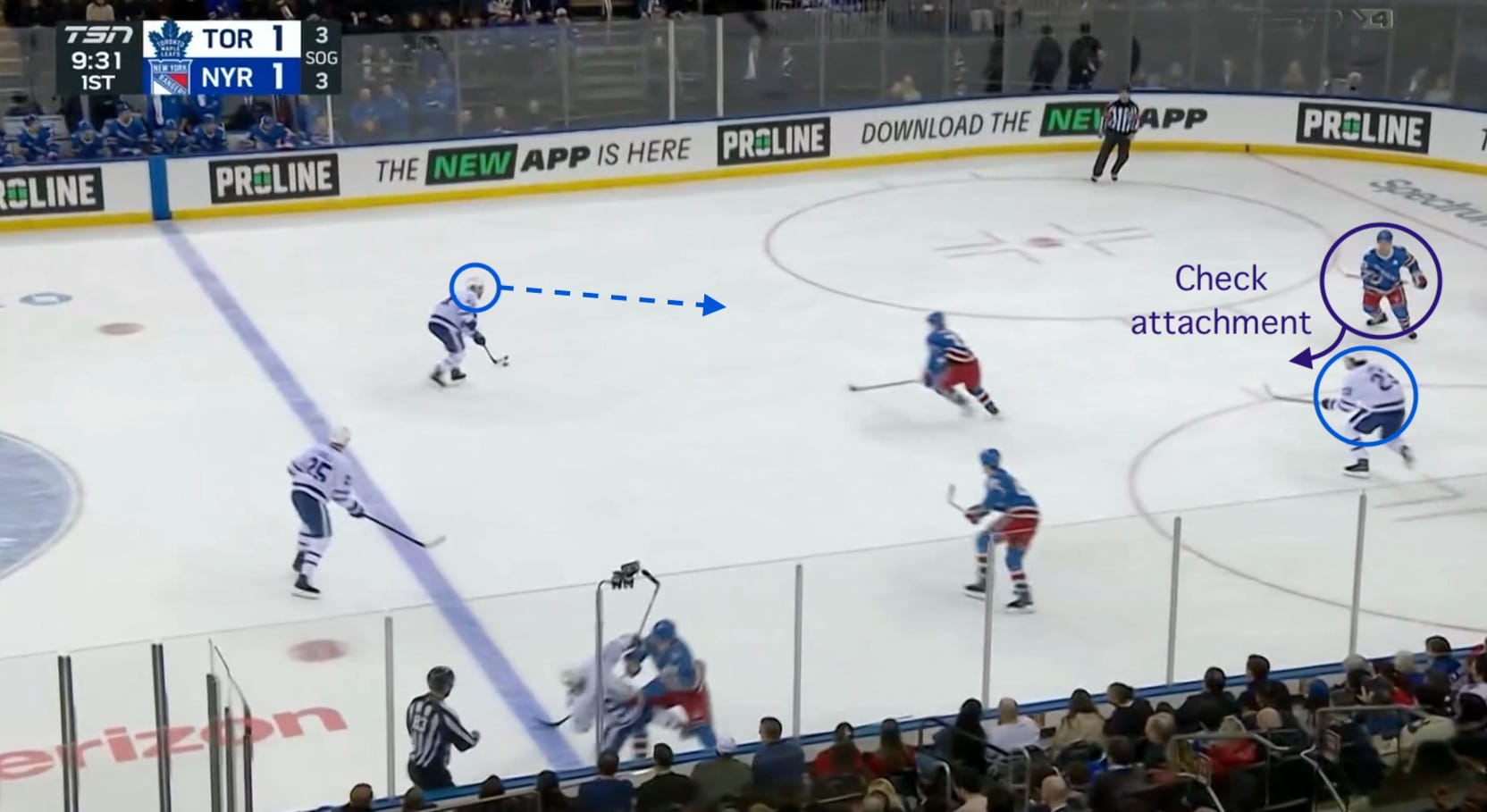
Morgan Rielly (TOR 44) has possession in a reasonable point shooting location. Not content to dig his heels in around blue ice, Fox strides forward in an inside-out trajectory to deny Matthew Knies (TOR 23) both the depth and interiority needed to bang on the door. Stick on stick is gravy:
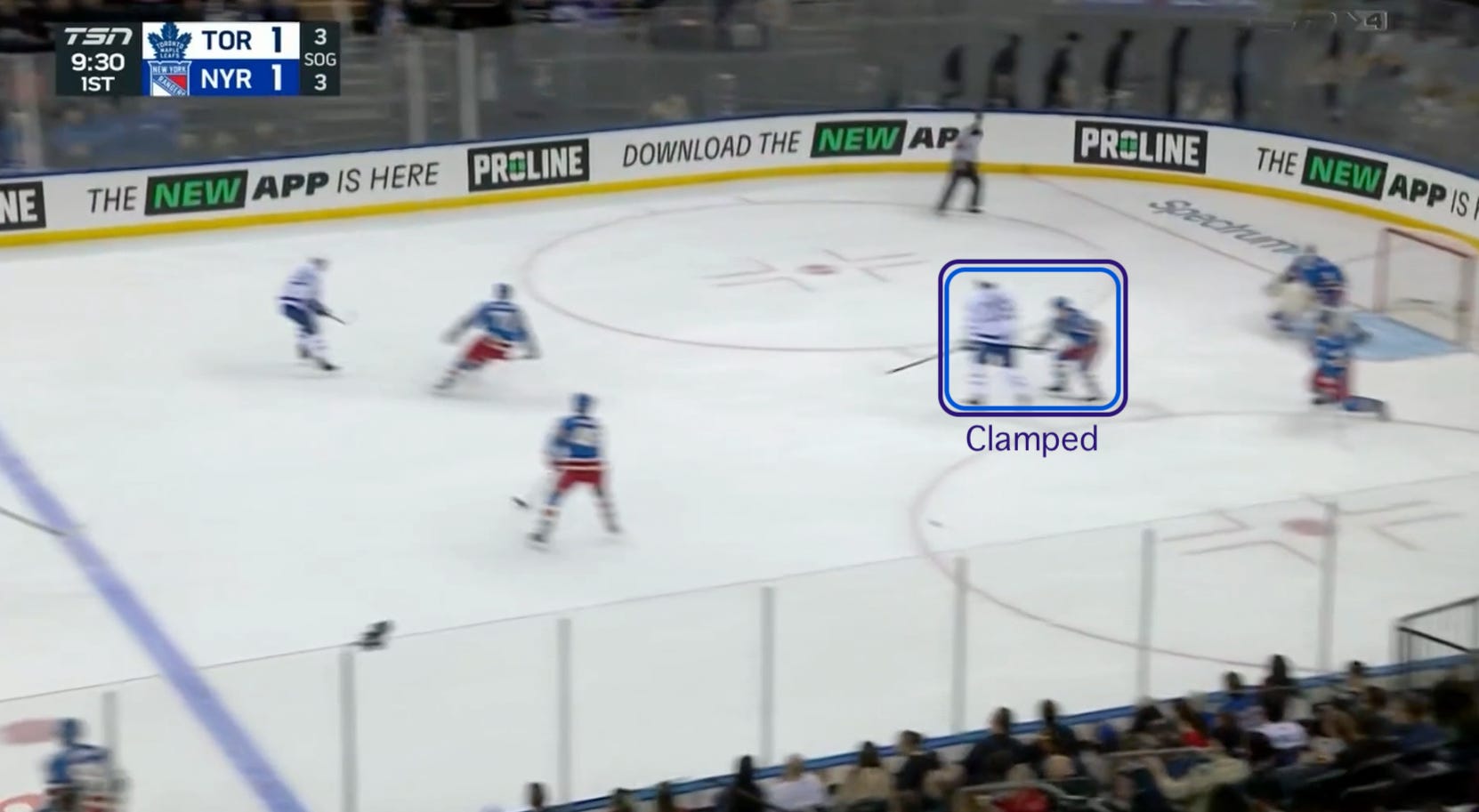
Lacking a worthwhile play to the cage, Toronto’s LD attempts a pass that banks off the high forward and lands on Easton Cowan’s (TOR 53) twig.
Charting an initial angle/depth with just the right amount of aggressiveness places Fox in the inside track as he and Knies edge back toward the near hashes. There’s no way the power forward can access the shooting lane in time to affect the flight of the puck:
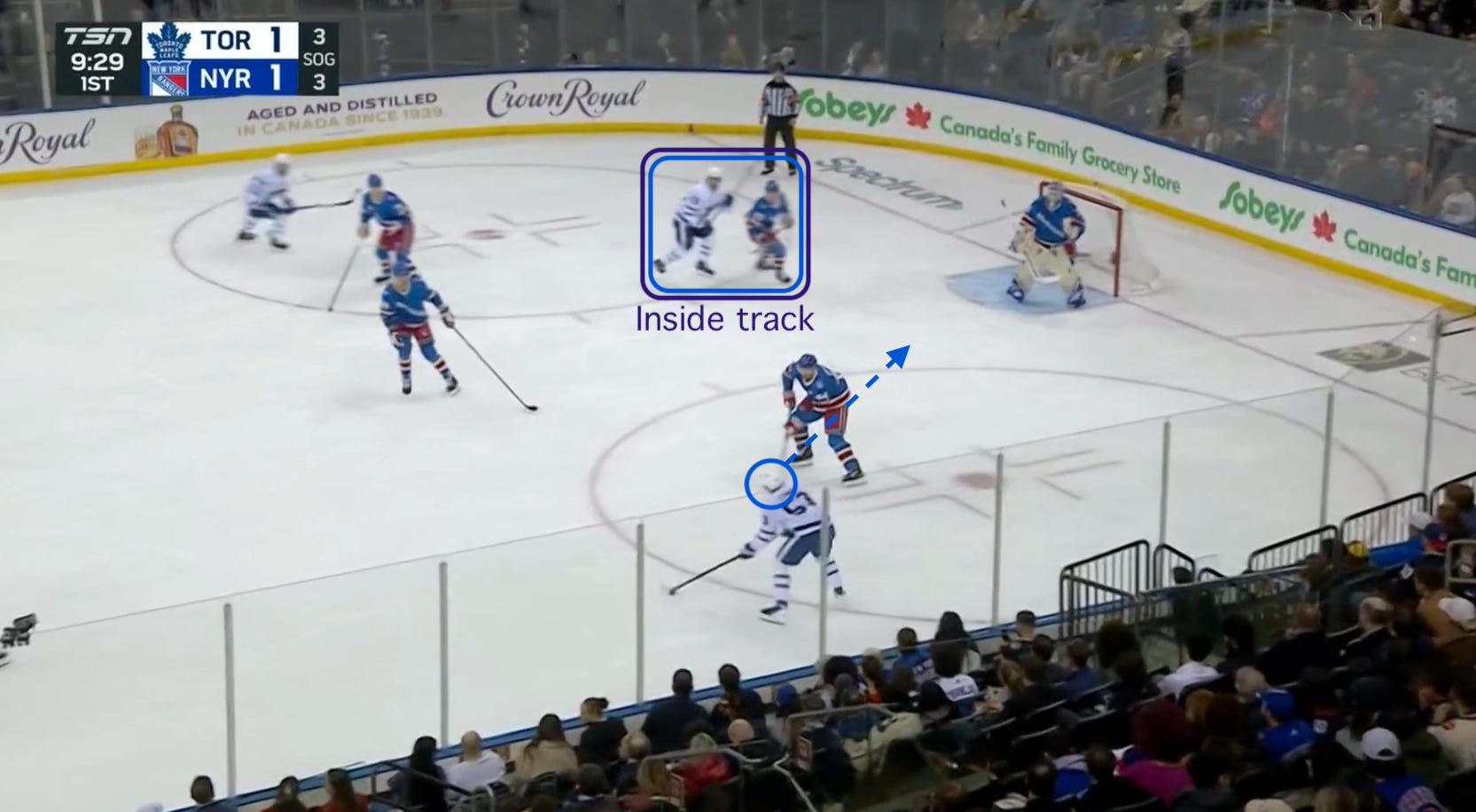
But just to be safe, let’s go stick on stick once more:
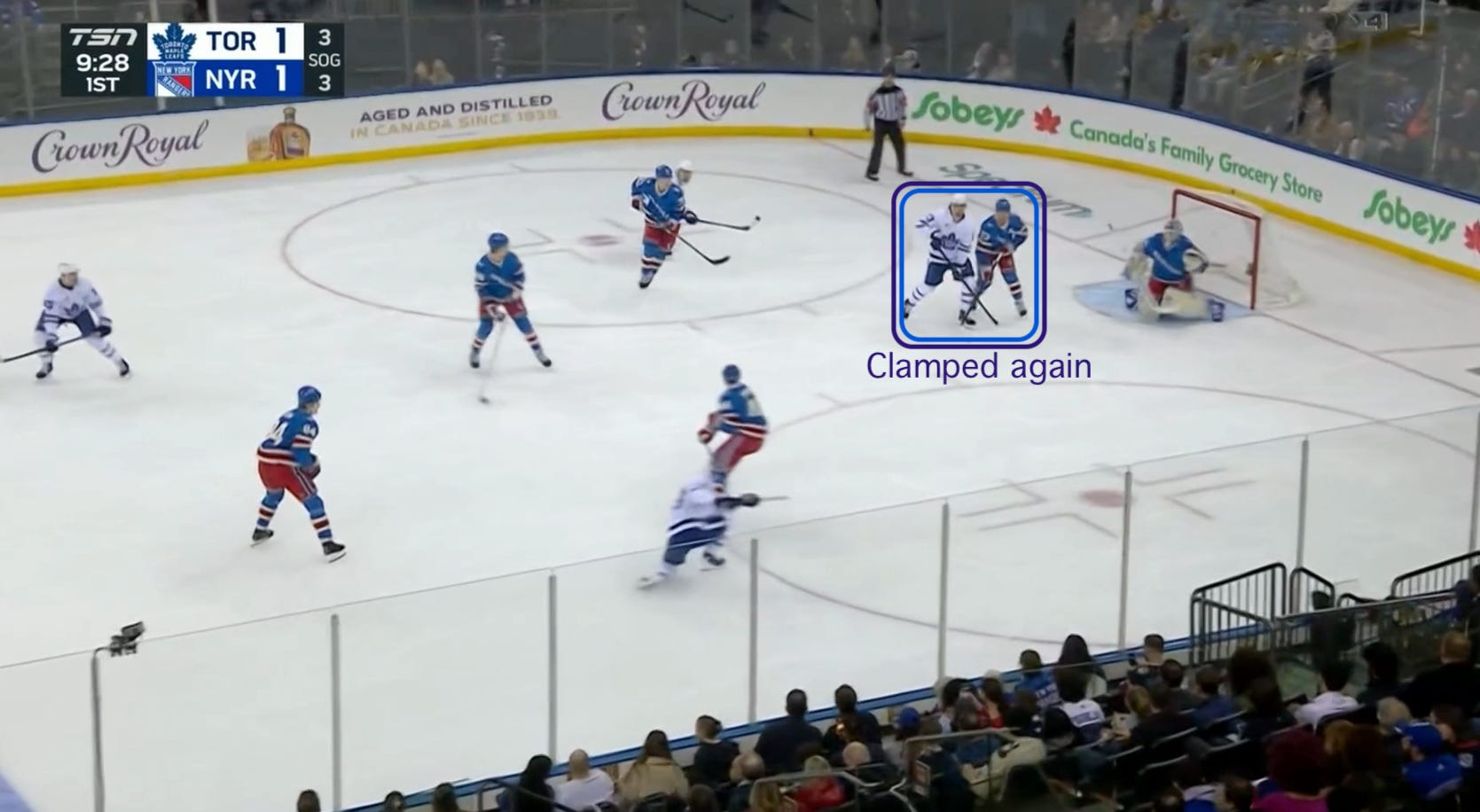
A sinking Rielly grabs the loose puck below the goal line and heads up the boards. He’s outnumbered on the strong side, though. Jaroslav Chmelar (NYR 49) is in position to pinch him off at the half-wall, whereas 6’7”, 232-pound Edstrom (NYR 84) can contain Cowan in the high slot. Rielly doesn’t shoulder-check for information at any point either.
Considering those variables, the LD is bound to opt for the safe play—and Fox recognizes it first.
While Knies attempts to piece together his D-man’s intentions, New York’s 1D peels off his cover to dart behind the cage, intercept the rim and kick-start his team’s transition up the ice:
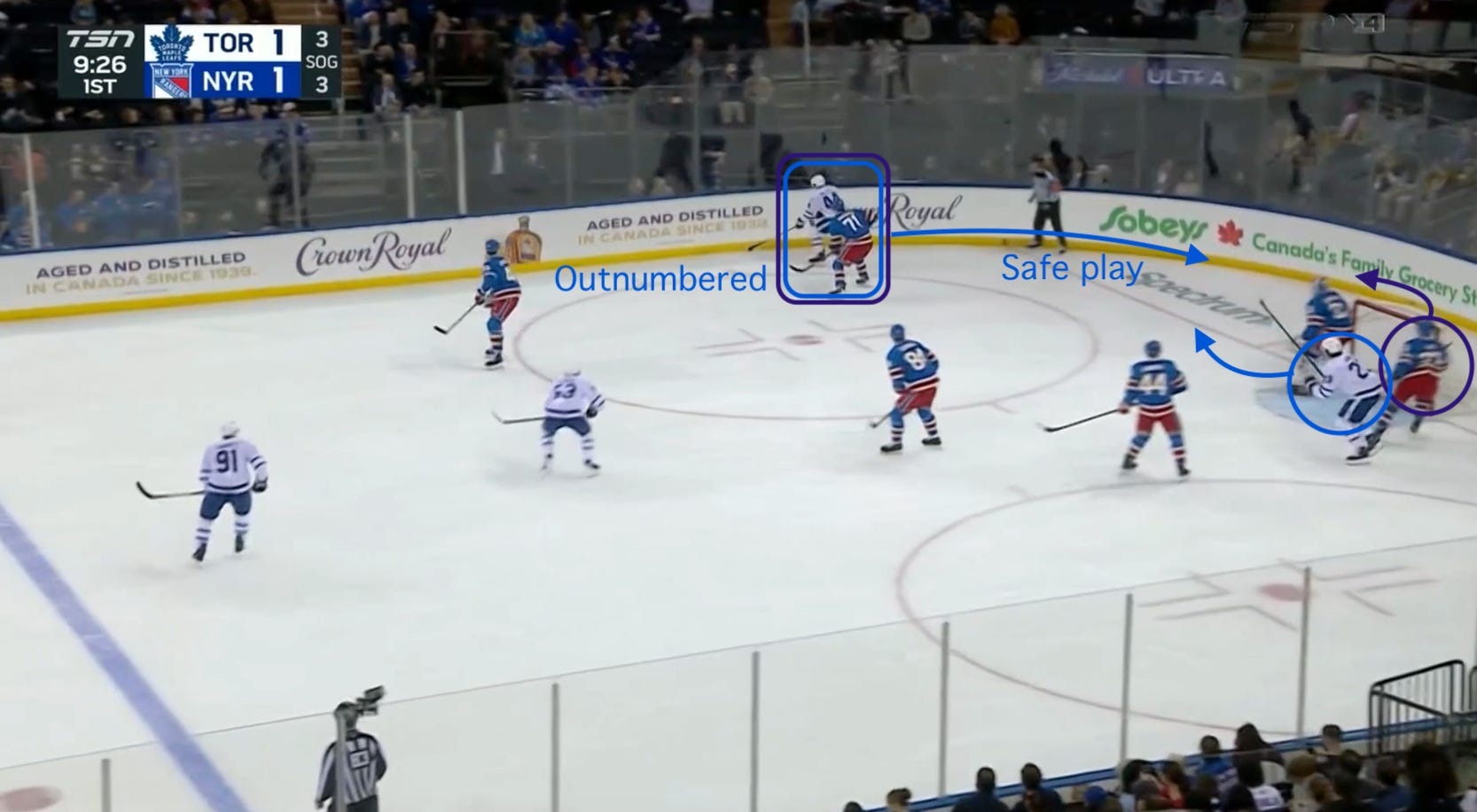
Knies is a tank who can rumble faster than his counterpart. He has the edge in every tangible category, yet Fox cordons off the good ice and beats him to the superior position on three separate occasions in the span of eight seconds.
Hockey sense is a beautiful thing:
A smaller defender excelling off the puck makes sense.
The fact that he’s equally stubborn on the puck is remarkable. Fox complements his macro-anticipation (i.e. what the offense wants) with keen micro-anticipation (i.e. what the puck-carrier in front of him wants). He continually susses out the timing and exact whereabouts of the point of attack, boosting his chances of disruption via stick checks, crouch blocks, etc.
In his backskate on 1-on-1 rushes, he’ll hold fast and only flip his hips to challenge the puck once he detects a dead giveaway:
Even in fire drills, he juices his body orientation for all it’s worth. Watch him negotiate this hairy predicament in the blink of an eye following a Gavrikov (NYR 44) turnover:
Your average—or below-average in the case of many puck-movers—defender would resign themselves to a Cowan scoring chance or dive straight out at Toronto’s young forward. Fox curls into the engagement to contest the release and clog the passing lane to Knies all at once.
Phenomenal white-knuckle stuff.
And that, in a nutshell, is what makes him such a rare breed. No star blueliner extracts more value out of the tools at their disposal. His, quite frankly, suck. Watch how his size/skating can hurt him in transition and on retrieval:
One false step or half-second late, and he’s done for.
To New York’s relief, the odd miscalculation is dwarfed by his shrewd, proactive reads. He somehow balances on that tightrope to dominate his minutes:
These are the defensemen who conceded the fewest high-danger chances last season. With the exception of Fox and Gavrikov, they ALL belonged to playoff squads. Many of them (Korczak, Cole, Spence, Kleven, Lauzon, D’Astous, Hanifin) were sheltered by their coach too. New York’s 1D was not. Stiff competition, weak roster…lowest HDCA/60 in the league?
I wouldn’t go so far as to label him a shutdown artist—he carries ample offensive responsibility and walks a finer line than Moritz Seider, for instance—but these are miraculous results.
When you consider what he brings to the table in transition and on offense, falling short of best-in-class defense isn’t the most damning state of affairs. He posted the third-highest expected goal share and highest team-relative xGF% in the NHL. His influence wasn’t merely reflected in the big picture. It shaped it:
Without his services, the Rangers played like the single worst team in hockey. I mean, what else is there to say? His three-zone sway is staggering.
Fox’s all-around impact has no business being as great as it is. Neither does his contract (3 years left at $9.5M AAV).
Should any whispers of discontent resurface, contenders and up-and-comers alike should inquire about the league’s quietest franchise defenseman. Hell, the 28-year-old has been hauling the Rangers on his back for so long that we may not have witnessed his ceiling yet.
Fantastic breakdowns like these make the offseason feel a little shorter.
Pittsburgh already overloaded with RD, but...
NYR probably won't trade with the Penguins anyway, right?