
Early Returns: Artemi Panarin
Moving to a different beat

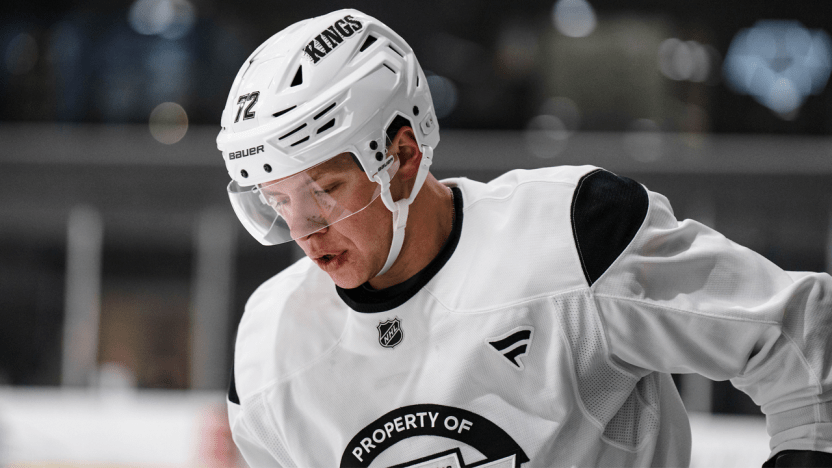
A vanilla tactician vs. one of the league’s premier freelancers. There was stylistic tension built into the Kings’ blockbuster trade for Artemi Panarin, and it took three games for Jim Hiller to find himself on the losing end. While L.A. may still miss the playoffs in 2025-26, any hope for the next couple of seasons hinges upon its willingness to embrace the winger’s unique talent.
Here’s why.
Transition Play
If you’ve followed the Breadman’s career, you’ll know that the only system he follows is his own. He’s going to play how he plays regardless. How much value you extract from his presence will depend on his ice time and deployment.
That inflexibility might sound frustrating on the surface, but his offense-first game has proven a net positive to previous squads. Despite the flash and riverboat gambling, his goal share has NEVER dipped below 50%. Moreover, his transitional toolkit has been a breath of fresh air for a Kings club that’s been suffocating by its own hand.
L.A. hasn’t gained the OZ with such ease in ages:
It’s easy to assume a NZ catalyst can burn with the best of them. In actuality, the 34-year-old might be the face of east-west hockey because of both said role and his underwhelming straight-line wheels:
No other player derives as much pleasure—or is as reliant upon—using the full width of the ice. This benefits D.J. Smith’s group in every phase, but it’s perhaps most important on zone entries. Panarin’s vision and trickery are sublime, spotting cross-ice targets and throwing all manner of feints (shoulder fakes, stutters, leg kicks) in order to buy himself and his teammate the beat they require to sync up.
His ability to sell defenders false information and coax them away from his favored lane is something to behold:
Naturally, this upgrade in team pace has resulted in upgraded rush offense too. I noted a few months ago that Panarin is among the top 3-on-2 passers in the league, waiting for the walls (i.e. the F3 and/or strong-side defenseman) to close in so that his recipients meet little to no resistance:
That skill has persisted on his new team:
The bad news for opponents is that his brilliant passing accounts for just half of his transitional repertoire. Even with his modest top gear, he can create separation himself thanks to ingenious technical skating. It almost seems like he spends as much time shuffling sideways or drifting backwards as he does traveling forward, and that spidery dimension bestows him world-class agility.
His movement may not pop the way, say, Jesper Bratt’s does, but the herky-jerkiness between his hands and feet makes for a deeply elusive puck-carrier.
Defenders seldom catch his drift, so they seldom stand their ground:
One of the main reasons for his 1-on-1 success is the frequency with which he attacks on an arc. This enhances three inter-related factors:
Maneuverability
Unpredictability
Middle-ice access
Instead of skating in a straight line, which would grant defenders puck exposure and simpler surfing calculations, he always has an avenue at his disposal to stay a hair beyond his defender’s orbit. He’s made his living off that very tendency. Here’s an example from Saturday’s contest vs. the Habs:
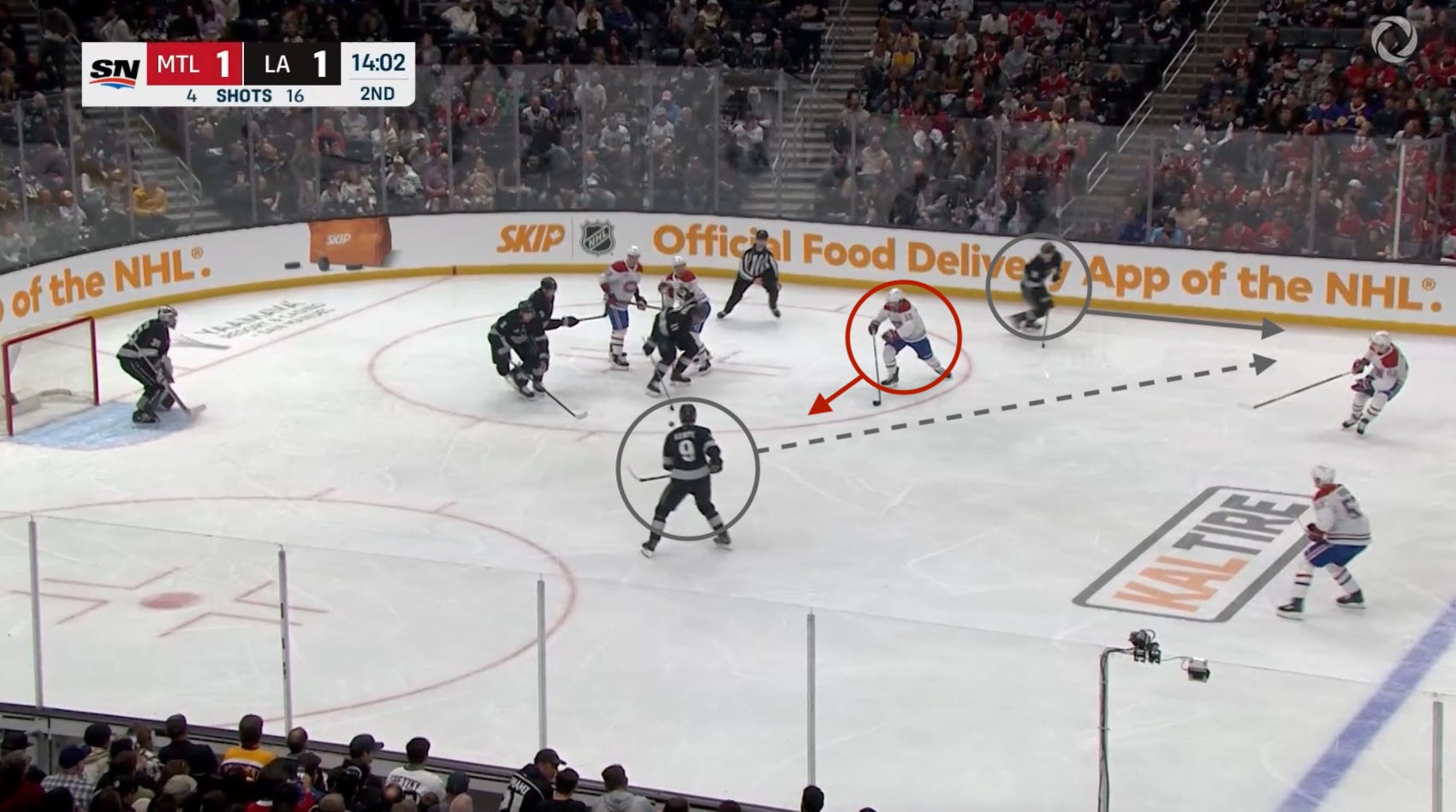
Anze Kopitar (LA 11) pokes the puck free to Adrian Kempe (LA 9) after a faceoff win. With Alex Newhook (MTL 15) bearing down on him, the winger requires an outlet. Panarin obliges by streaking up the far wall.
Upon his reception, Lane Hutson (MTL 48) pivots forward in hopes of killing the Kings’ offense ASAP:
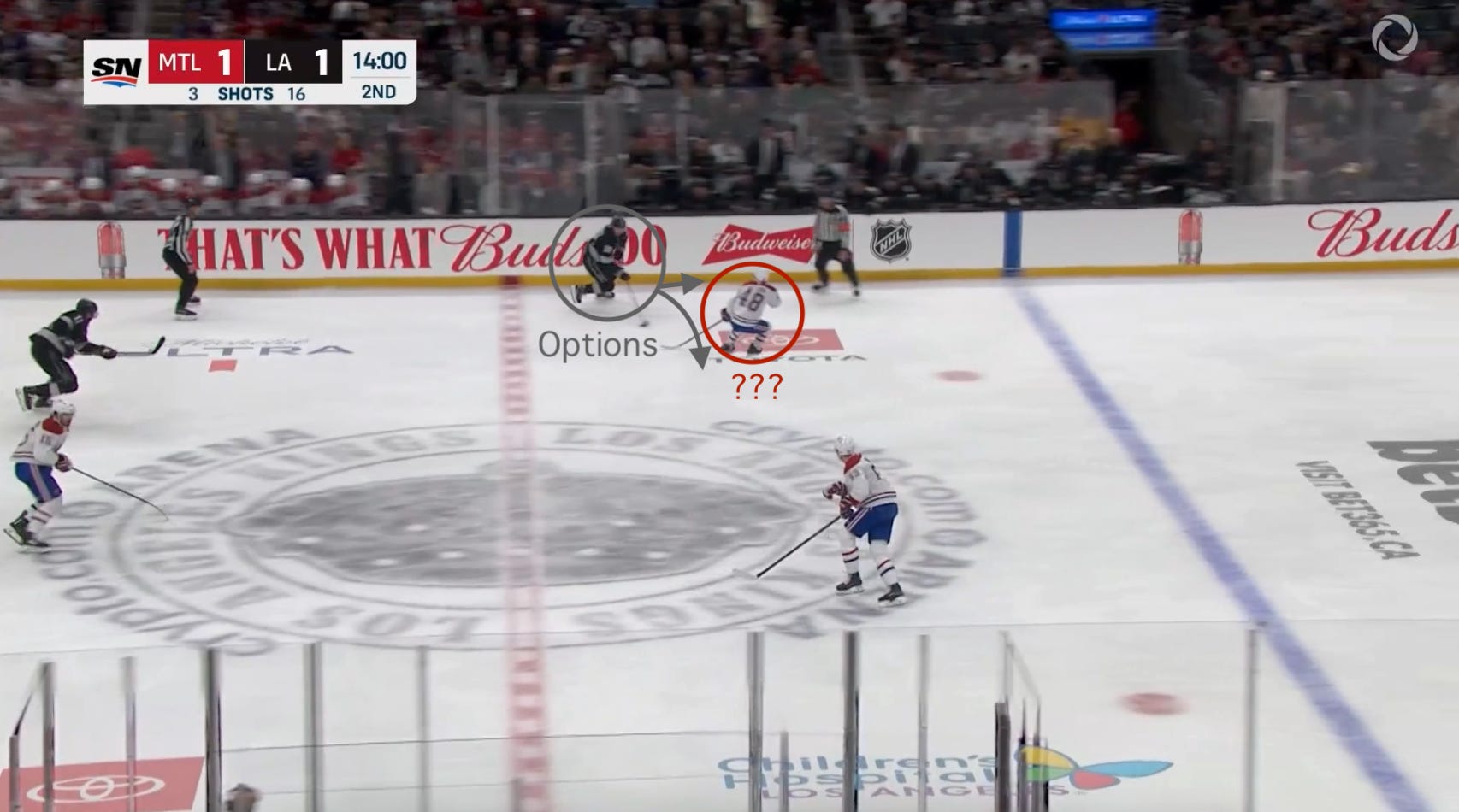
Unfortunately for him, the Russian has already charted an arcing path. Unable to suss out his counterpart’s intentions, the blueliner is forced back onto his heels and surrenders the guts of the ice. Panarin then looks to carry Hutson to Noah Dobson’s (MTL 53) side, stacking the Habs’ back end to generate acres of real estate for the trailing target (Kopitar):
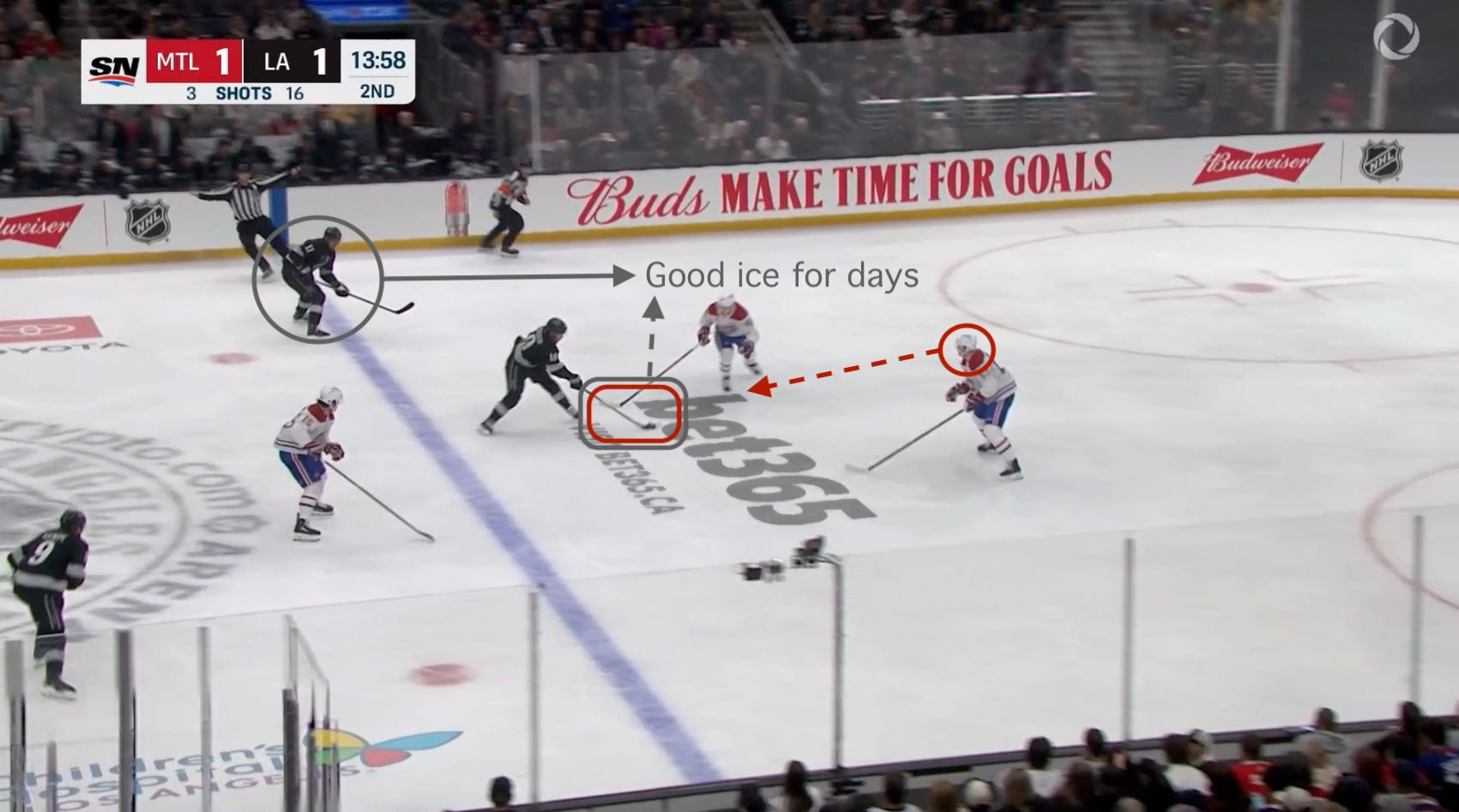
Although Montreal would love for Dobson to slide over before the advantage materializes, he sees a star winger threatening to attack from middle ice. You can understand his half-second of hesitation.
That’s all L.A.’s talisman needs to punish you:
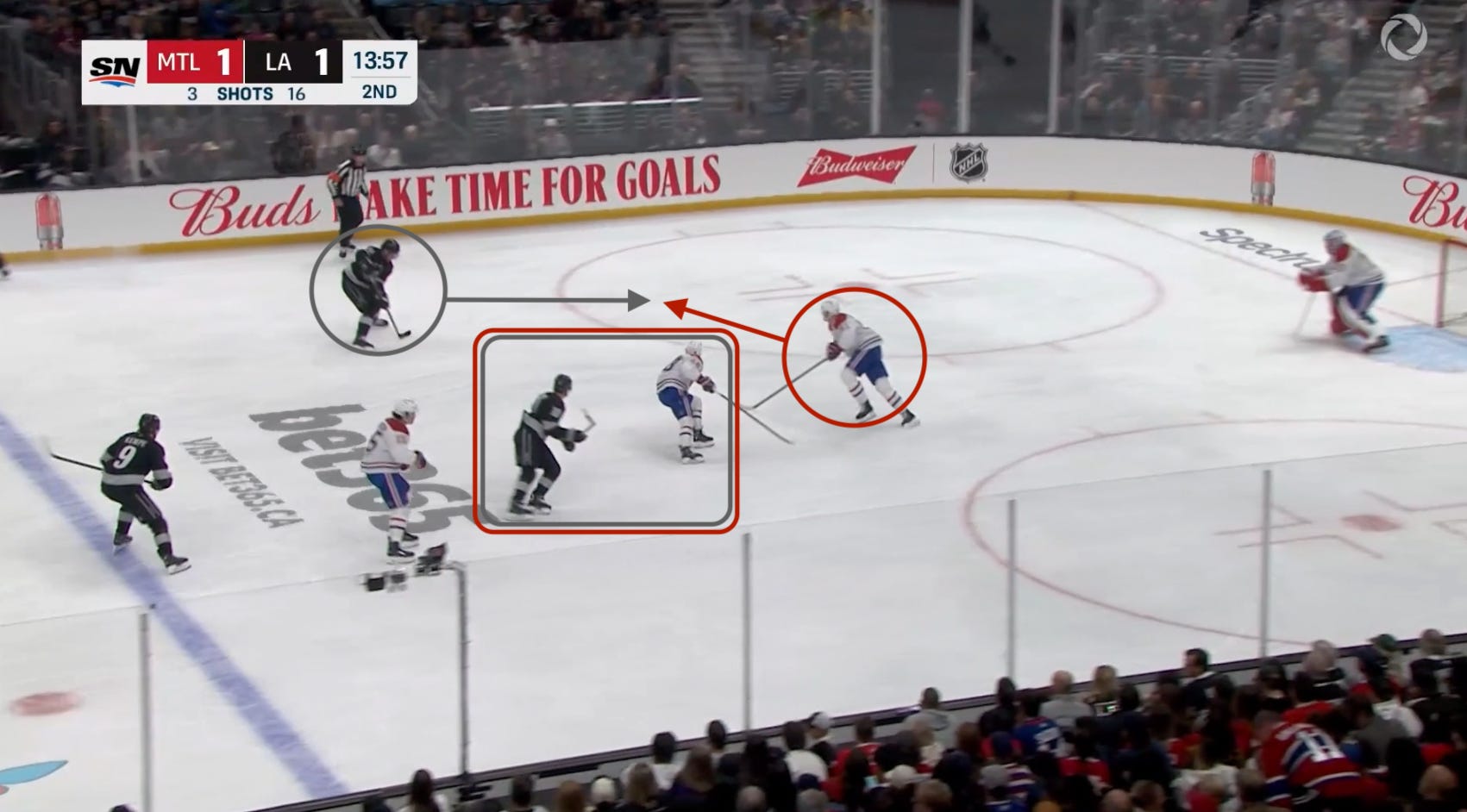
With Dobson out of range, Panarin’s dish under Hutson’s stick offers his captain a prime scoring opportunity manufactured from a 2-on-3:
His crafty skating, feel for available space and pinpoint passing routinely stretch the defense’s lateral seams to create opportunities it isn’t prepared for. From a broader perspective, his something-out-of-nothing skills yield greater control over the action. Less energy depletion from chasing pucks down. They can get into their offensive sets early and often.
Through eight games as a King, that pattern has held firm. He ranks second in shot attempt share while drawing the opposition’s top defenders and has totally revitalized the first line in the process. Consider the before/after numbers:
In addition to strengthening the top unit’s statistical performance, Panarin’s arrival has introduced a measure of interplay that we haven’t witnessed in L.A. since…I don’t know, the LAPD line?
Spurred by their new linemate’s boldness, Kopitar and Kempe are no longer afraid of unleashing their full talent. They’re chaining together passing sequences that defy the current core’s meat-and-potatoes roots. Their sudden taste for creation is palpable, and they’re eight games into this partnership.
We’ve glimpsed a fraction of the Panarin effect.
Dual Threat
Two years ago, I discussed the extent to which a shot-pass balance augments Panarin’s offense. He’ll always think apples first, but posing a legitimate scoring threat takes his entire arsenal to the next level.
His move to the West Coast must have delivered a kick in the pants because he’s increased his volume of late. More specifically, his shot attempt rate on the power play (a game state in which you have time to size up your touches) has catapulted from 33.6 to 43.7. By committing to mixing in his own looks, he’s refusing to tip defenders off. They don’t have a clue what he’s got in store:
Panarin has been flowing between modes to mystify opponents in the OZ. However, he’s tickling the twine at a lower clip (0.72 vs. 1.05 goals per 60 minutes). Is that a matter of puck luck? Maybe. His underlying metrics suggest he’s been more dangerous in L.A.
There’s something to be said for shot selection, though.
Particularly on the PP, the Breadman has been firing pucks that aren’t in his personal wheelhouse. He’s never boasted a lethal one-timer, yet he’s been uncorking them like he’s Ovie:
While these qualify as “good shots” (i.e. well-executed setups to a somewhat dangerous location), it’s apparent that Panarin isn’t in his element as a trigger man. He isn’t a stationary one-touch assassin (e.g. Nikita Kucherov) either. This is a playmaker whose influence on the game is predicated on time of possession. He thrives on extended touches, and his dual threat bubbles over when he’s on the move. The slightest bit of momentum draws his ELITE deception to the fore.
This is critical to a Kings club whose scheme often restricted its foot soldiers to contested one-and-dones or outside touches. The Russian rests on the opposite end of the spectrum. He’s very much a soft perimeter winger, but his puck skills and knack for manipulation generate a wealth of chances inside the hashes.
An extra pump opens up an A+ corridor at the 11th hour. The forehand cradle to the inside is a classic that grants him breathing room to fire on repeat. The look-away cross-seam passes have been magic since the Patrick Kane days.
Countering his wizardry is no small feat:
The sequence below captures Panarin in his flow state:
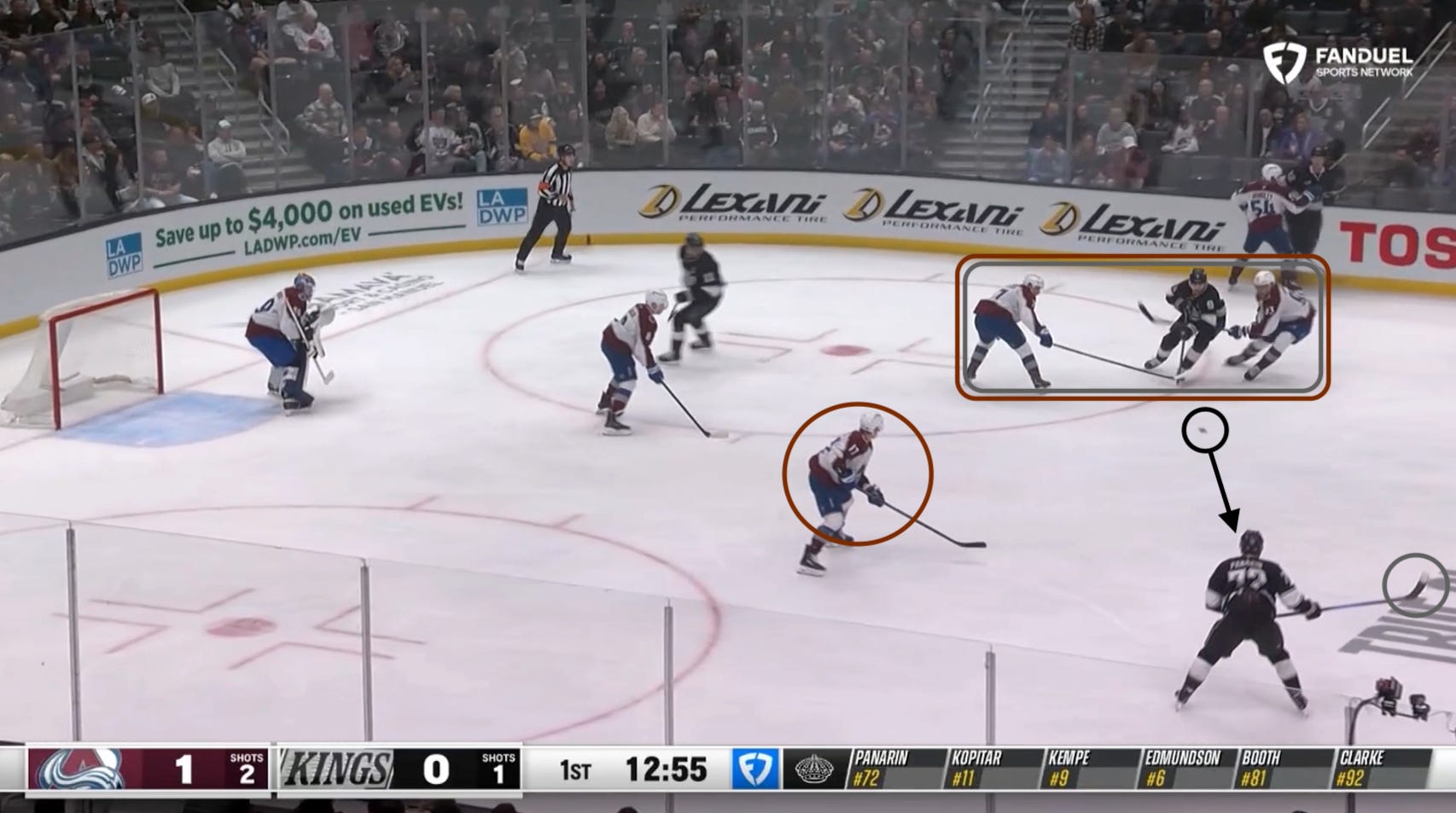
Sandwiched by Avalanche defenders, Kempe muscles the puck to Panarin on his off wing. Decent shooting opportunity from distance. Now count the number of Colorado players to the left of the dotted line:
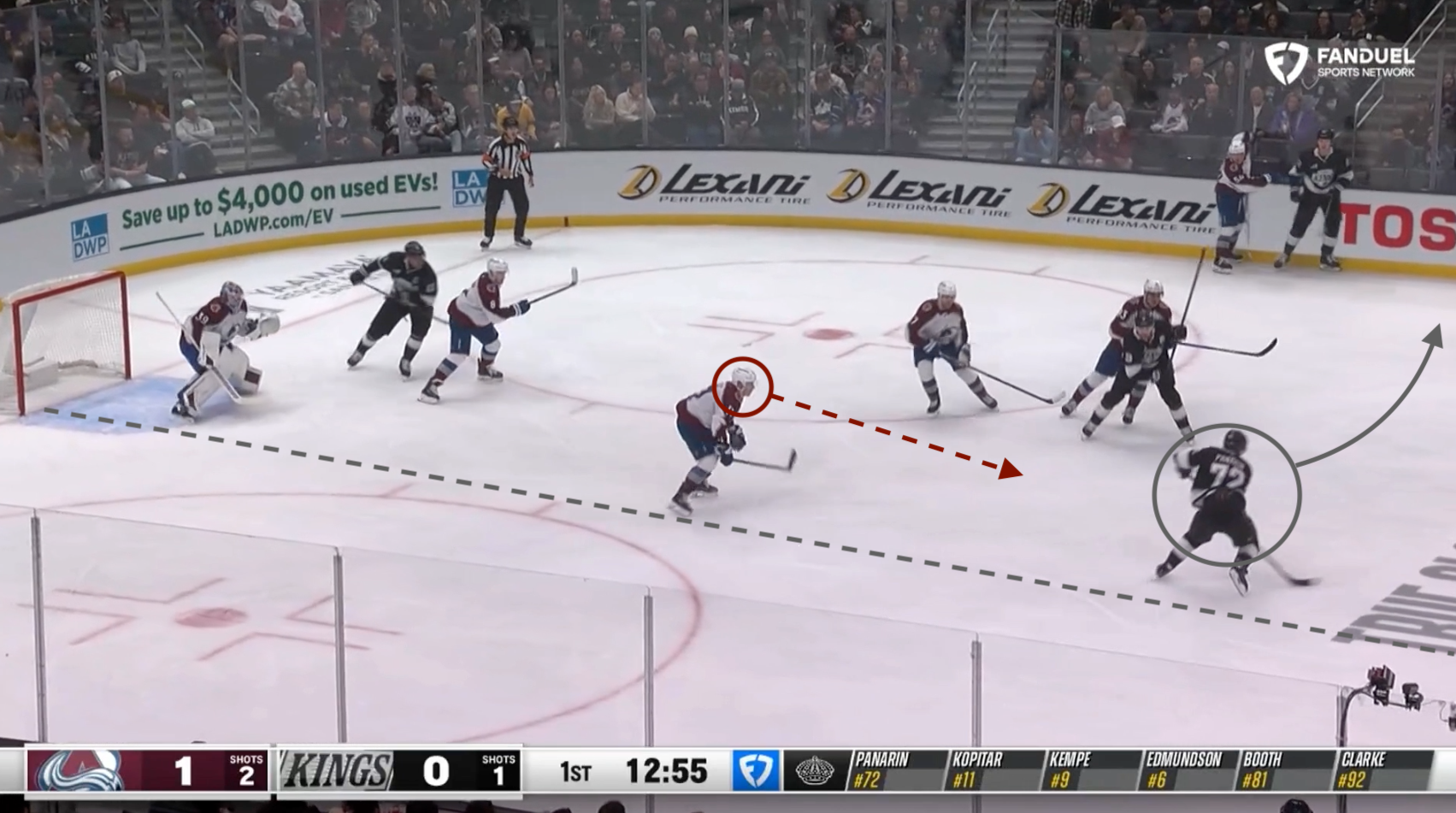
If he can lug the biscuit back to the strong side, he should be able to draw the would-be blocker (Parker Kelly, COL 17) there as another Colorado player marks Kempe’s rotation. LD Angus Booth (LA 81, off screen) could therefore end up free and clear. Panarin catches, steps into the busier half of the OZ and the opposition’s high man-on-man coverage is suddenly all out of sorts:
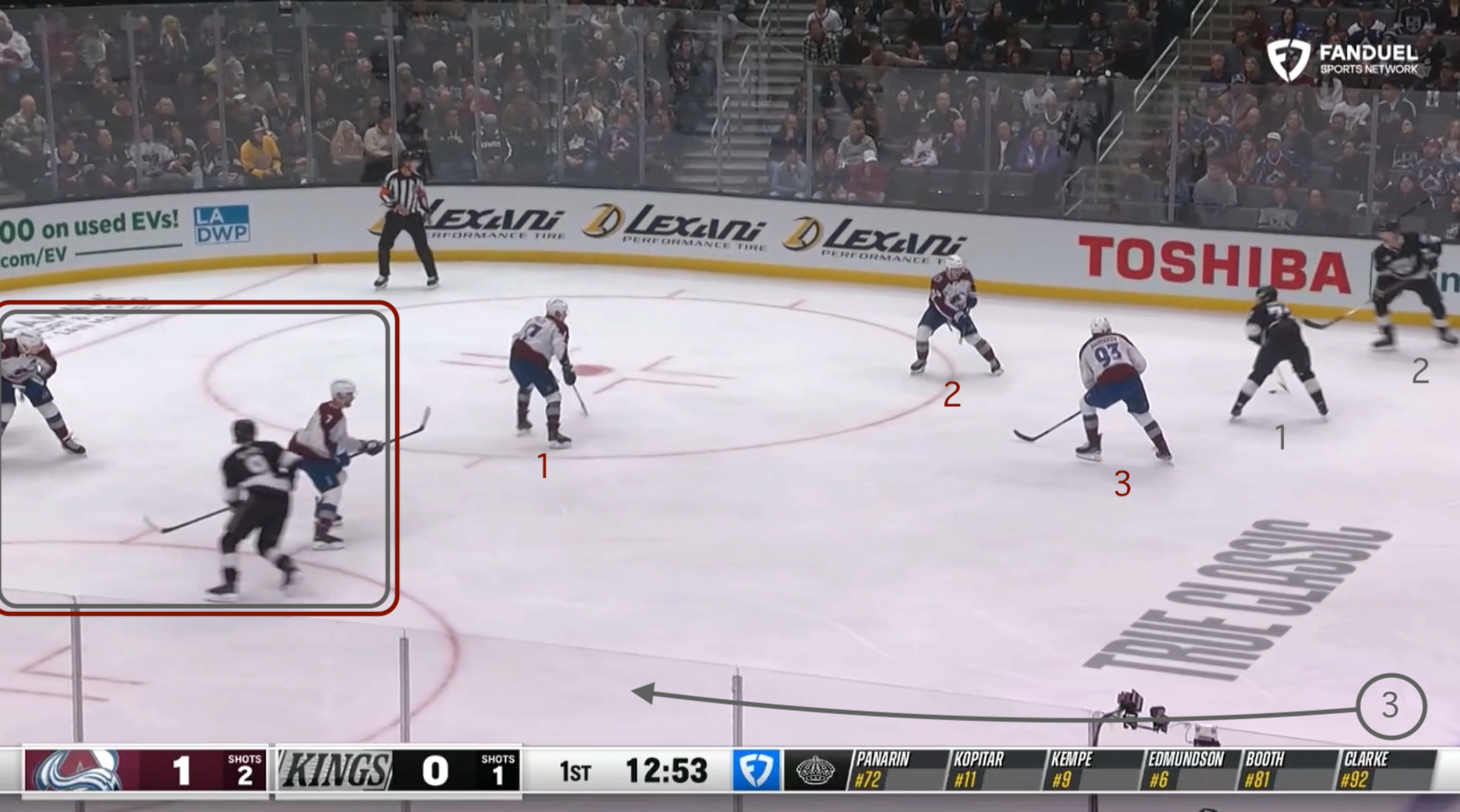
Ideally for the Avs, Gavin Brindley (COL 54) sticks to RD Brandt Clarke (LA 92) and Zakhar Bardakov (COL 93) hinders his countryman’s progress enough for Kelly to close the distance before switching to left point containment.
But this is Panarin. You don’t want to offer him any daylight, so Bardakov pursues the puck-carrier back to the right side, signals Kelly to come claim him and latches onto the next nearest King (Clarke). Having watched a teammate steal his assignment from under his nose, Brindley must now scramble to figure out his new job. That doesn’t go well:
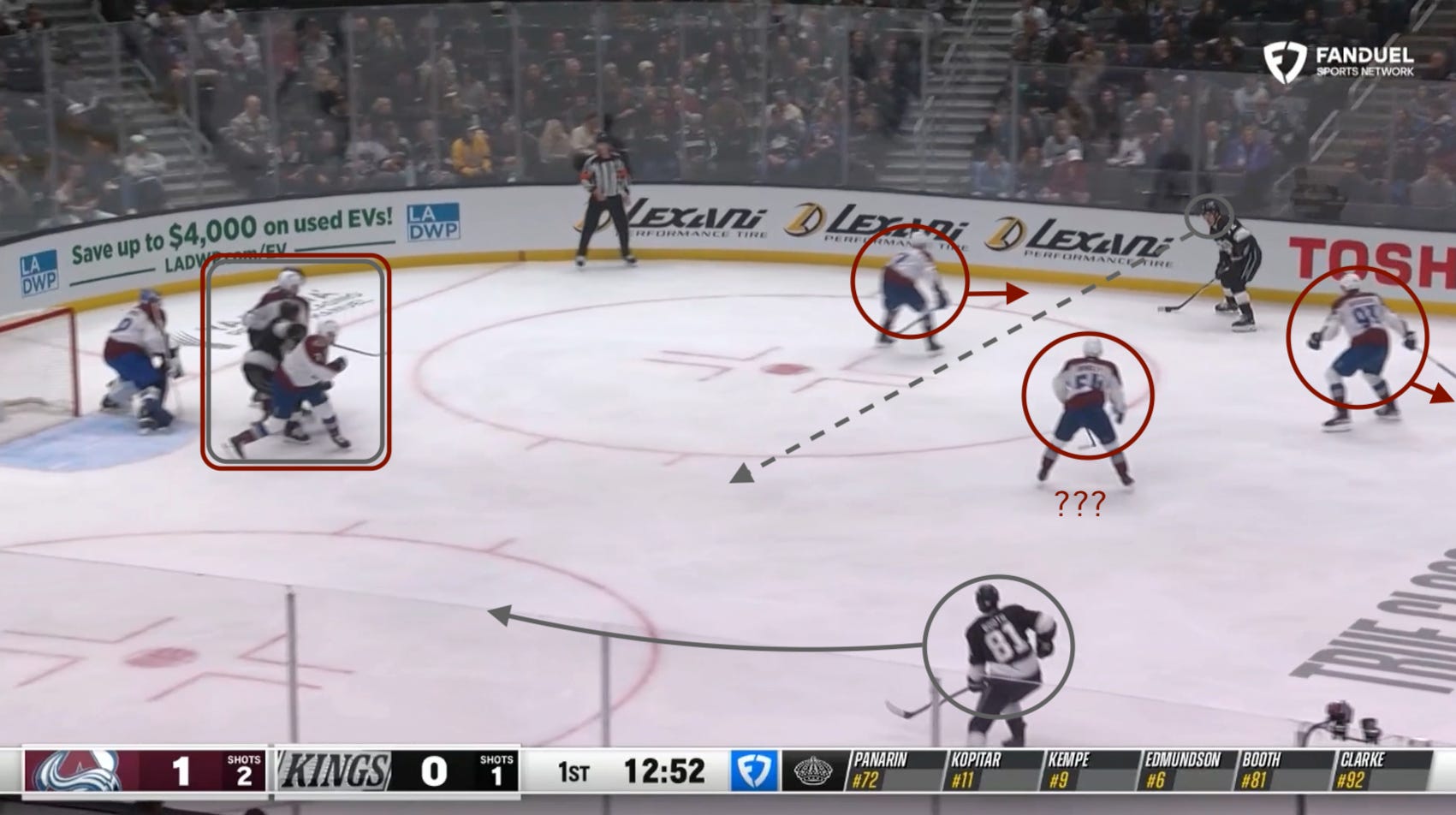
This is a rare occasion on which Panarin’s accuracy fails him. Despite the errant pass, he soaks up so much attention and sows so much confusion that Booth has an eternity with which to make a play:
Even when he’s not the primary distributor, Panarin’s involvement in three-high designs can reveal cracks within the opposition’s defense:
Although his raw output (8 points in 8 games) has been a tad disappointing by his standards, the Kings feel different when he’s on the ice. His command of the action pins defenders on their heels and softens their five-man posture, which affords him and his teammates the time and space to run scissor exchanges, explore multi-level seams and send their D-men screaming downhill.
They can cook in formerly airtight kitchens. It follows, then, that L.A.’s offense shines brightest during his shifts. He leads the Kings in team expected goal rate and is on another planet in goal-scoring rate:
Yes, his 14.3 OISH% should normalize over the coming weeks, but don’t get it twisted: Outpacing his teammates in GF/60 is business as usual.
While he may not lap the field in other on-ice categories, quality reigns supreme. His deception and crisp execution pack every chance he orchestrates with additional danger. Defenders are entranced by his efforts. Goaltenders are asked to track pucks across the royal road. Targets drift in and out of view at several depths. These are flat out better looks than what the team’s rigid system has mustered over the past decade.
Alas, sparking the Kings’ top line may not suffice in 2025-26. As of this writing, they trail Seattle for the Western Conference’s second wild-card spot. If they fall short, so be it. The blueprint for a fresh start is worth more than a 700th consecutive early exit anyway.
Kopitar’s on his retirement tour. Drew Doughty’s squarely in his twilight years. The Kings extended a 29-year-old forward for eight seasons and brought in a 34-year-old star for another two (with trade protection included).
The long-term vision is…dodgy.
What’s done is done, though. The team needs a front-line driver to take the wheel, and Panarin is the lone figure on the roster who fits that designation. Since Hiller proved that more of the same won’t cut it and the Breadman will receive a team-high $11 million AAV, L.A. might as well hand him the keys. Dancing to his rhythm may keep that cliff at bay for a while longer.
Incredible breakdown. Quite honestly, I wasn’t aware that hockey analysis was this detailed and precise. Thanks for sharing your skill and intellect. What software do you use for video breakdown? I ask because I coach youth hockey and want to make our video clips easier to watch and learn for our boys.
Fantastic analysis once again. Rangers sputtered so bad this year I wasn’t watching a lot of Panarin. Interesting Kings expected goals chart too.