
Breakout Alert: J.J. Moser
Has Tampa found its Forsling?

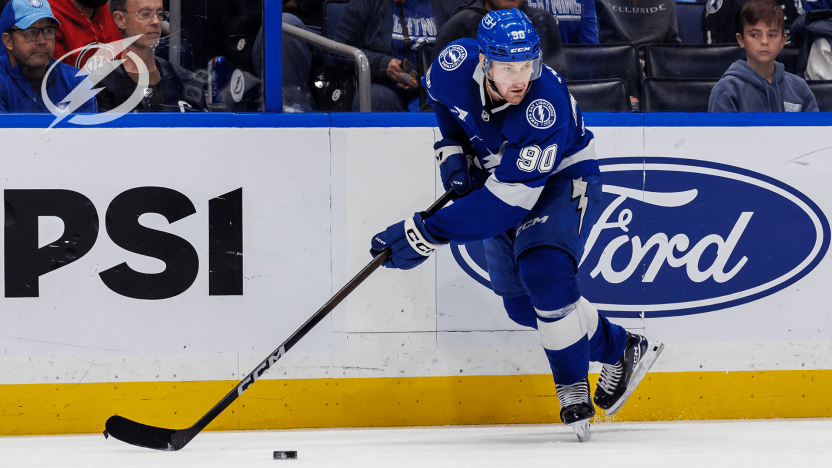
With minute-munching veterans Victor Hedman, Ryan McDonagh and Erik Cernak missing 20-plus games, Tampa Bay’s defense should have fallen apart. Instead, Jon Cooper’s troops have never been stingier. Through 48 games, the team ranks second in goals against and fourth in expected goals against.
This isn’t about Andrei Vasilevskiy.
A makeshift top pairing of J.J. Moser and Darren Raddysh is powering the Lightning’s airtight play. Here’s how the former, in particular, has launched his defensive stock into the stratosphere.
Puck Pressure
The signs were there in 2024-25. Alas, a lower-body injury hampered him for the back half of the campaign.
Healthy and more familiar with Tampa’s scheme, Moser is blossoming into a borderline shutdown defenseman this season. In many ways, he’s the Lightning’s version of Sunshine State rival Gustav Forsling—an irritating three-zone presence who refuses to let opposing stars breathe:
Not only does the 25-year-old apply heavy puck pressure, but he applies it as early as possible. Whereas most defenders aim to hinder controlled entries, he’s hellbent on ruining controlled exits. Unlike Forsling, however, he isn’t blessed with the mobility to facilitate this rangy style. His top gear and average playing speed are run of the mill.
Moser’s proactive defense hinges on immaculate timing. The moment he senses Raddysh loading up a bomb from the point or the opposition counting on a rim, he points his toes north. That consistent head start explains why he wins so many races. It’s similar to high-end offensive D-men skating into their catch, except he’s content to roll down the wall and bolster his club’s numbers around the biscuit.
His No. 1 priority is suffocating the opposition:
If he can augment the Lightning’s offense in the process, that’s gravy. The sequence below illustrates his talent for prolonging their zone time:
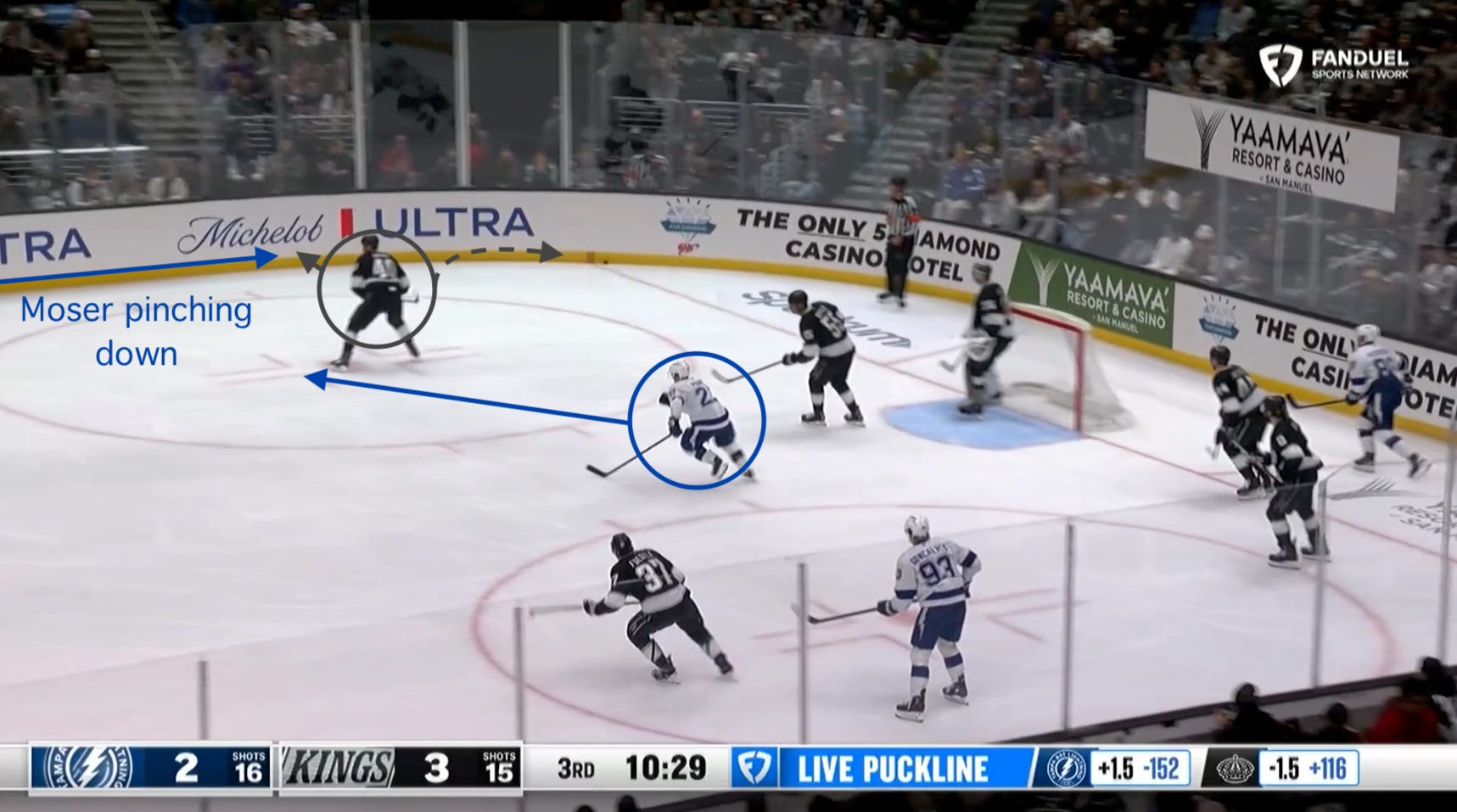
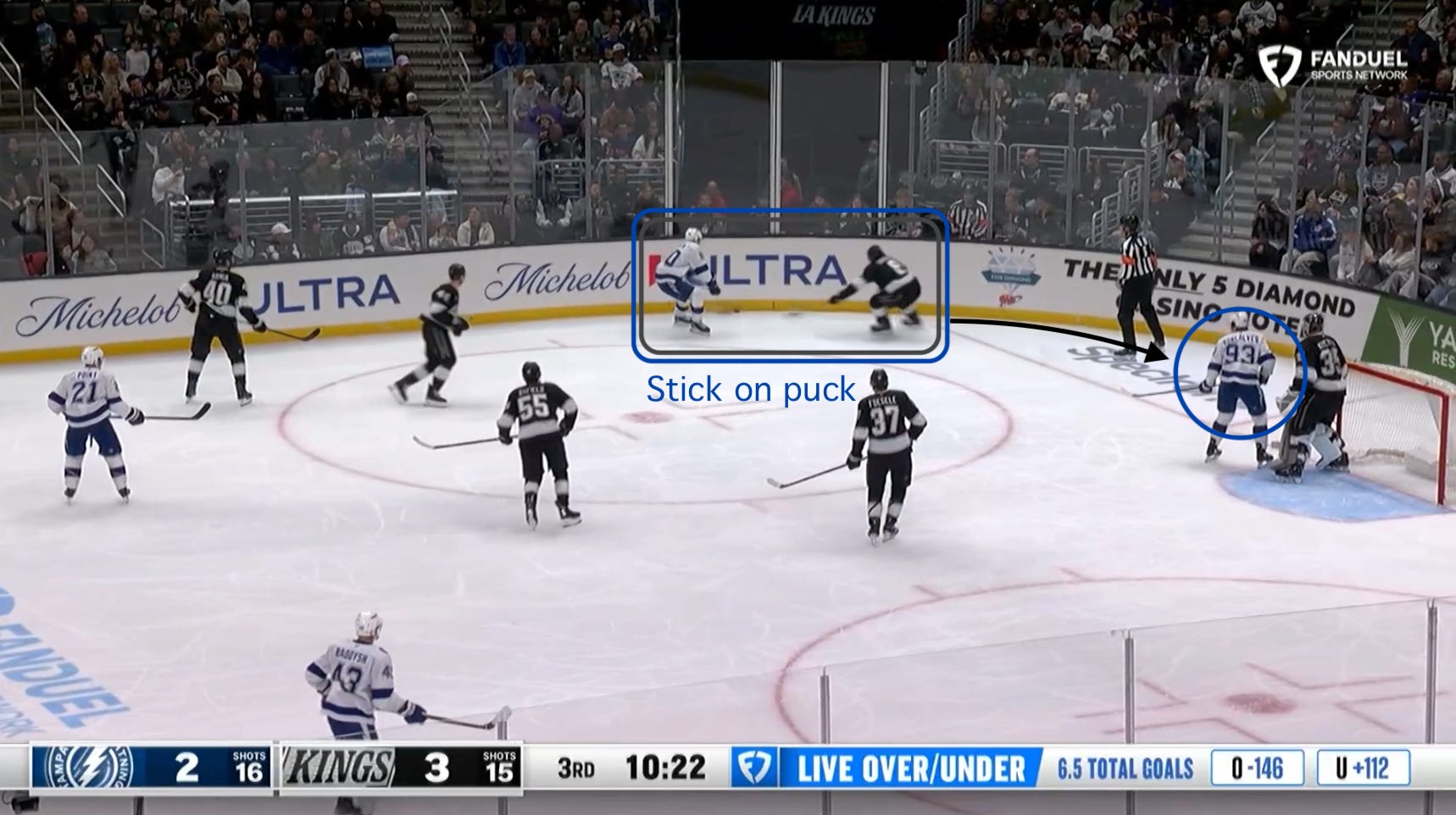
Kings forward Joel Armia (LA 40) is set to recover the loose puck but takes a suboptimal route. Rather than curling in to meet it and seal the boards with his left hip, he glides toward the wall in a straight line. This leaves a slim window for Moser (TB 90, off screen) to disrupt the retrieval.
F3 Brayden Point (TB 21) is climbing back up the OZ in support, amplifying the defenseman’s green light:
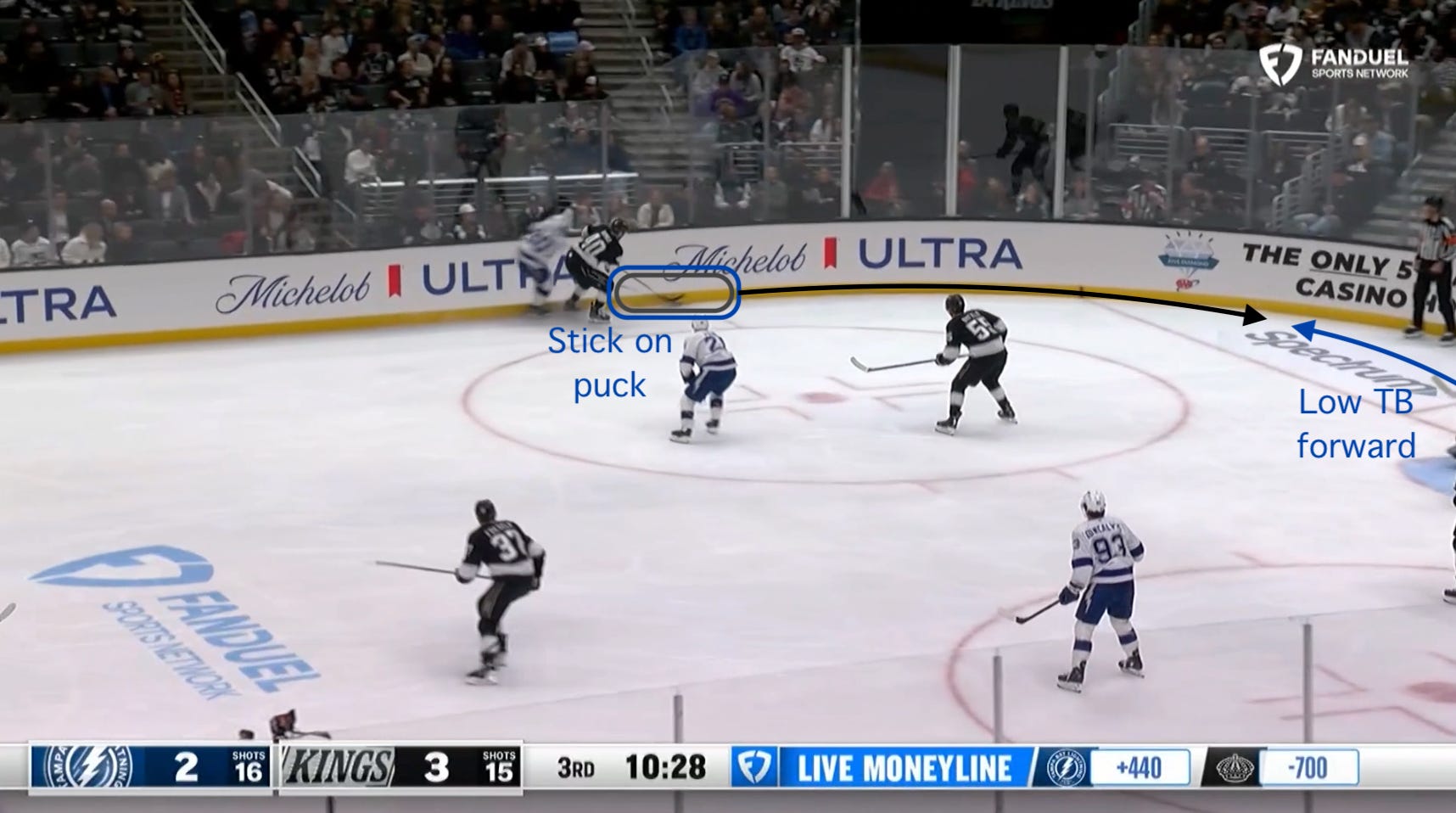
Moser does indeed go stick on puck, poking it to the corner where Nikita Kucherov (TB 86, off screen) is prepared to pounce:
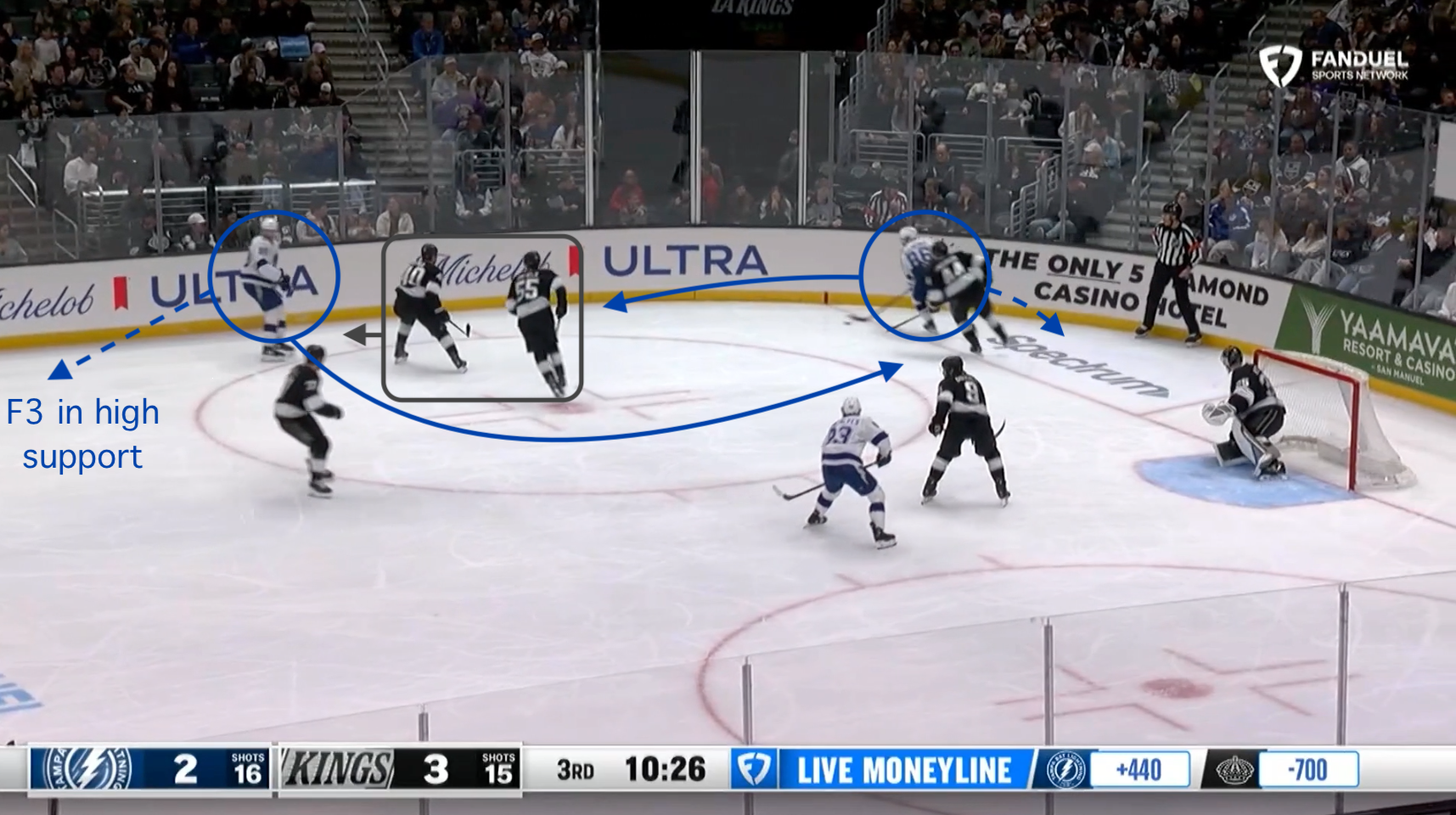
There’s no prime shooting threat for Tampa Bay’s talisman to connect with and tenacious defender Mikey Anderson (LA 44) is hot on his heels. Given the maze of bodies drifting up the strong side, Kucherov decides to play it safe. Chip down low —> hope Gage Goncalves (TB 93) can produce a stalemate or better vs. Drew Doughty (LA 8).
As Kucherov sizes up the situation, Moser glances back to determine whether he can double-dip in lieu of retreating to the blue line. Point remains in sound position, so LD1 capitalizes on L.A.’s forwards not knowing whether to treat him as a forward or point man.
Once again, he gets the jump on everyone else:
Doughty, who was convinced he had dibs on the loose puck, now faces a different challenger—and Moser beats him to the spot by a hair. Two would-be Kings recoveries amount to Lightning possession below the goal line:
For an ordinary (albeit smooth) skater, the Swiss Olympian displays complete faith in his keep-in reads. Remember the old stay-at-home template? He’s the polar opposite type of defensive D-man, tailoring his habits to stay away from home at all costs. He doesn’t wait for the action to arrive. He hovers around the fray for any opportunity to crash down and pin opponents on their heels.
When they are able to access the NZ, the tough sledding persists. Moser gaps up quite well thanks to his aforementioned fluidity. Clean transitions, smart angles. In addition, much like along the OZ wall, his twig-body dexterity will thwart your progress in a hurry.
Try to advance on his side, and the puck just springs back in the other direction:
Many high-pressure defenders come up short on answers when their stick fails them. Moser avoids this predicament by refusing to fly by. His anticipation guides him to the point of attack, he reaches in to spoil your catch, then he takes a chunk off you for good measure. He insists on initiating contact to prevail on at least one front. Regardless of where the puck ends up, he’ll muzzle your momentum. When paired with his timing, that fundamental 1-2 can swallow your transition game whole.
Yes, there’s a sneaky-physical dimension to his defense. We see it on opposing outlet passes, but it’s perhaps even more evident in chip-and-chase scenarios:
Three damn near identical plays from the same game. Moser vs. Carl Grundstrom (PHI 91). Watch how his feet and inside arm muscle the F1 off the puck line. He effectively hand-fights his way to a box-out and doesn’t bother recovering the puck himself. He simply ensures that a teammate can scoop it up before Grundstrom so that Tampa can re-fire its transition game.
Three dump-ins —> three none-and-dones.
Now, there is a downside to Moser’s aggro disposition. Especially on pinches, the swiftness with which he springs forward reduces his F3’s margin for error. Hesitate for a fraction of a second, and you’re chasing a counter:
The odd leak aside, however, Tampa’s forwards have filled in admirably, enabling Moser to trust his gut and ambush the opposition on repeat. Play-extending pinches, a NZ stone wall and a moving blockade on retrievals. He’s introduced a three-zone wringer this season, and it’s generating sparkling numbers:
Moser (56.9 CF%) and Jake Sanderson (56.2 CF%) are on another planet in terms of shot attempt share vs. elite competition (350+ minutes at 5-on-5). If you weren’t aware, I think VERY highly of Ottawa’s 1D.
Tampa’s de facto LD1 has joined that elite company by virtue of a simple philosophy: The best defense is offense. Its quality is determined by the likes of Kucherov, Point, Jake Guentzel, Brandon Hagel, Raddysh, etc. He’s laser-focused on its duration. When he’s out there, opponents can’t even adopt an attacking mindset because they’re stuck on the back foot.
In-Zone Defense
For all of Moser’s territorial dominance, he still finds himself in the DZ 37.8% of the time at EV. That’s just the nature of this chaotic sport.
Luckily for the Lightning, his game-wrecking ability carries over to that setting as well. Whether he’s foiling your bids on the rush, glued to you in the slot or scrambling to silence scoring chances, he’s always in your path. There’s just no shaking this dude in spite of his middling wheels:
His in-zone defense features a level of assignment discipline that differentiates him from your average stopper. He only puck-watches during fire drills, and in a role defined by the tiniest of margins (i.e. you have to nail your leverage and depth), his alertness is a true blessing to his club. Moser is proving that he can hunker down and blanket his mark with the best of them.
On net drives, he’ll tie up and carry you to the nearest post in order to shut the passing window. When he detects an incoming point shot, his body traces a firm boundary in the slot and he gives as good as he gets. Rebound and deflection chances are thus few and far between.
Flying under his radar is hopeless. He will engage you in the slot. The fact that he frequently stands his ground closer to the hashes than the crease—thereby lightening his goaltender’s cognitive load—is a credit to his processor. By the time forwards settle on a plan, he’s already identified it and entered obstruction mode. Moser has mastered the art of “legal interference,” presenting enough resistance to impede/redirect their off-puck routes without resorting to the kind of ‘90s-style mauling that would trigger a penalty.
Here are some recent examples of his check attachment:
Yeah, he’s a pain in the ass. To make matters worse for opponents, he maintains an ice-cold demeanor when Tampa's zonal responsibilities are jumbled (e.g. the offense floods one quadrant) or its posture implodes.
Depth is what fuels his success in these situations. The 2021 second-rounder possesses an innate feel for hedging between targets. He has the composure to play chicken on low 2-on-1s, not over-extending but daring the puck-carrier to opt for the less dangerous choice. On the rush, his internal clock informs how long he’ll face forward and occupy real estate before darting to the back post.
Combine his depth and anticipation, and you’ve got a blueliner who can defuse scoring chances at a moment’s notice:
The following rush shines a light on his stellar DZ spacing and decision-making:
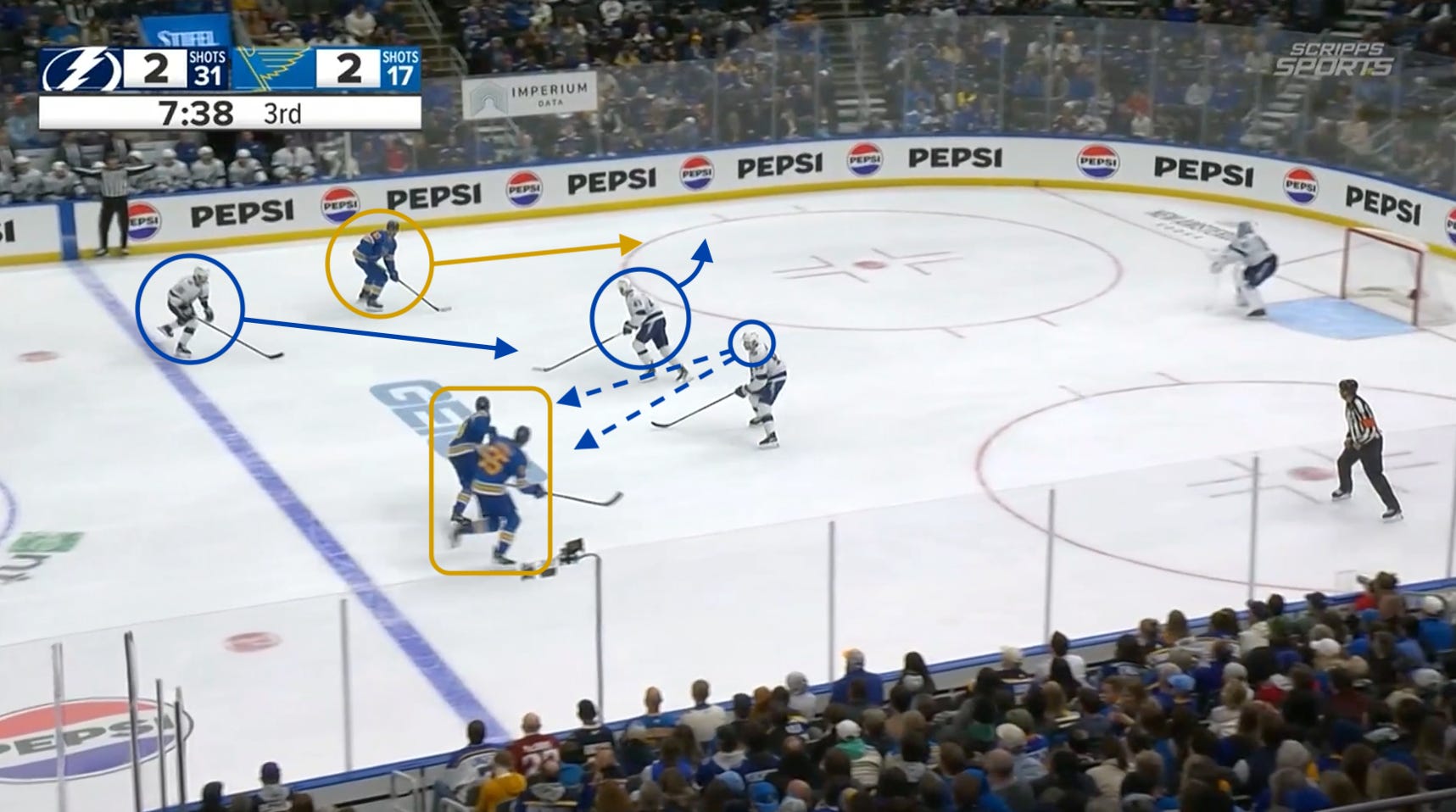
Partial 3-on-2 for the Blues. Raddysh is shading over to the puck-carrier (Brayden Schenn, STL 10), whereas Moser is out-manned on the left. He has to keep a central berth to delay Schenn’s pass and rope F3 Kucherov into the picture:
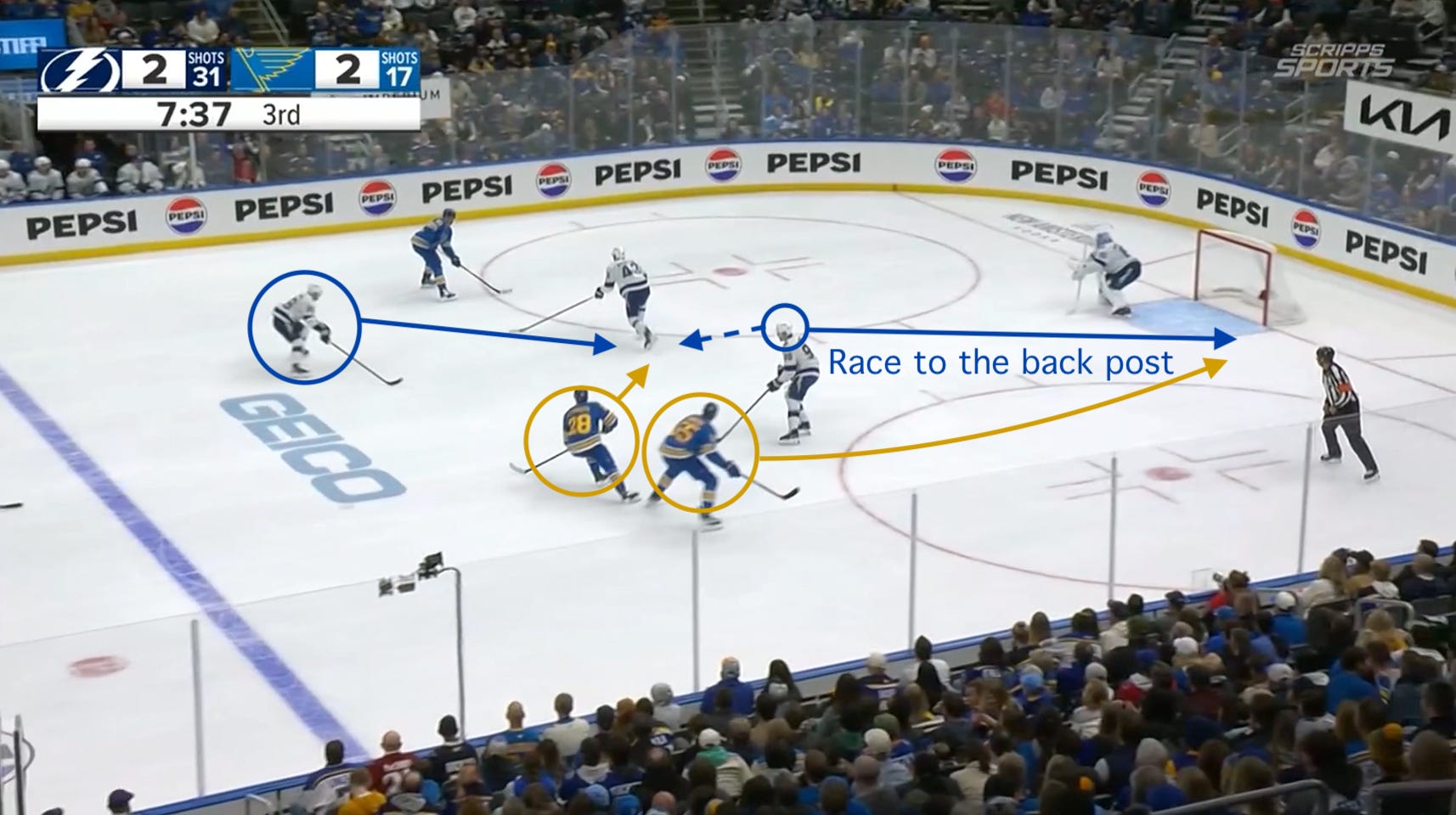
Final scan before he must pick up either the middle (Otto Stenberg, STL 28) or wide driver (Colton Parayko, STL 55). With Raddysh shepherding Schenn to the outside and Stenberg skating on an arc vs. Kucherov’s straight trajectory, Moser believes Parayko is the bigger threat. It’s now a race to the back post.
He demonstrates some clever skating here, switching off his backskate to eke one last push in and increase his wingspan at the point of attack:
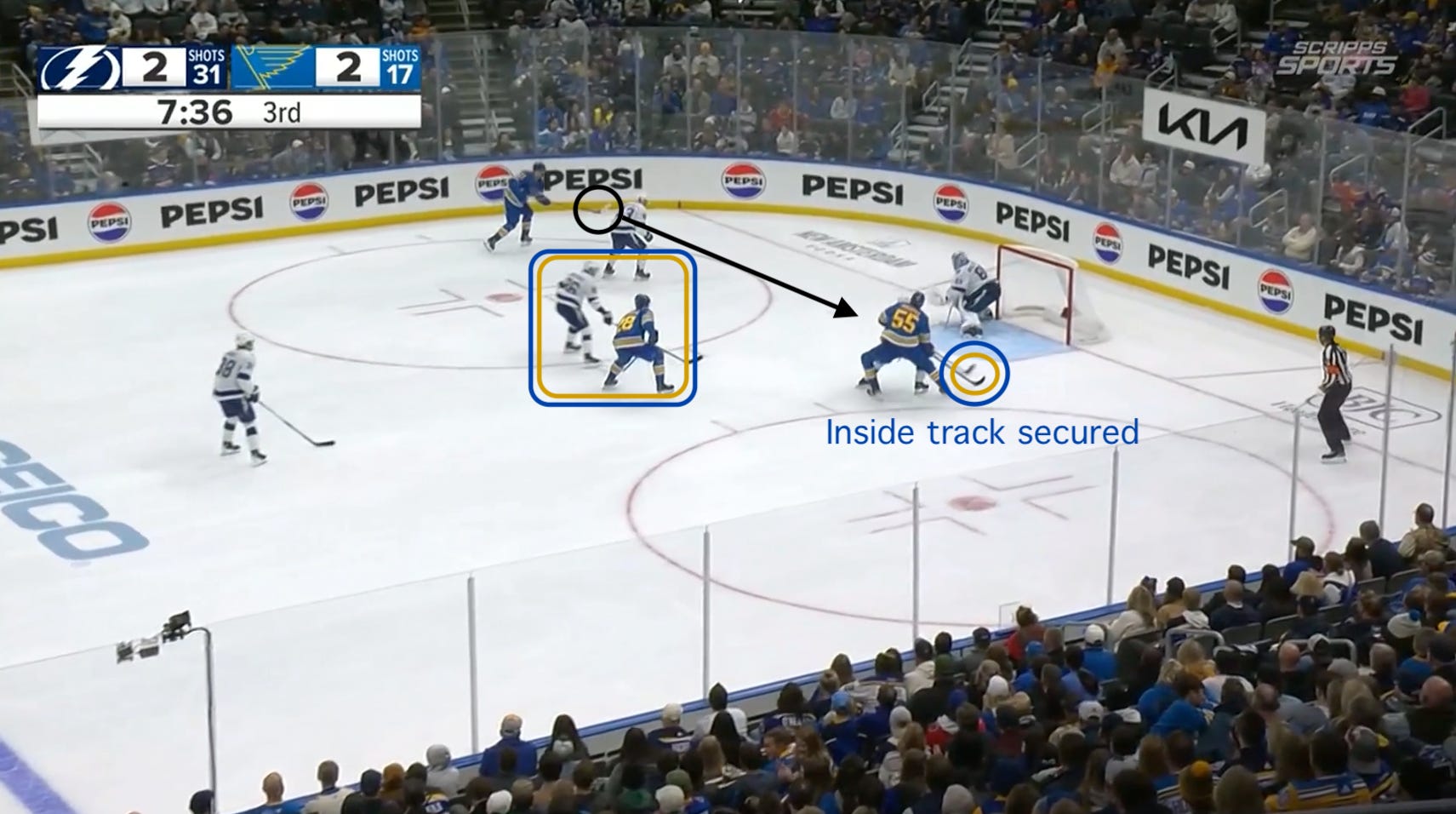
Schenn is forced to the outside, Kucherov catches up to Stenberg by the near hashes and Moser secures the inside track on Parayko, knocking the high-danger pass to the end boards:
When Tampa’s installed in its structure, he and his cover are packed in a tin can. When opposing forwards work their way to an advantage, his last-man-back patience and positioning stupefy them. Shot vs. pass becomes a proper conundrum because it feels as though he’s in range to affect either option. His presence is ever-palpable down low.
“He's like an eraser. Every time something breaks down, he erases the mistake. And it's great to have him back there.”
Moser’s puck pressure and point-of-attack defense have undeniably benefited his five-man unit. Among the D-men who have logged 700+ minutes at 5-on-5, he’s conceding the second-fewest scoring opportunities and HD chances. No one’s remotely close to his goals-against rate:
Remember, this is while absorbing the toughest usage on the Lightning’s blue line. We’ll need a multi-season sample to drop the “borderline” qualifier, but the ingredients are there for a legit shutdown defenseman (hence the 8-year, $54M extension).
Cooper couldn’t have asked for a more promising development. Considering the back end’s rash of injuries, keeping its head above water would have been wonderful. Somehow, on a roster headlined by one of the greatest playmakers in NHL history, the Moser-led defense might actually form the team’s sharpest competitive edge.
Since Tampa has found suitable linemates for matchup center Yanni Gourde (Zemgus Girgensons and Pontus Holmberg) and the Cirelli-Hagel duo is a two-way handful, its forward corps is playing its soundest hockey in years. Moser’s climb into the upper echelon of stoppers puts the defense over the top. Meanwhile, his steadiness has granted Raddysh the freedom to discover his offensive potential at age 29 (42 points in 42 games).
When Hedman, McDonagh and Point return to the lineup, you’ll be hard-pressed to flag any weaknesses.
The Lightning…could be ready for another title push.
Amazing article—I love the way you displayed his strengths, while acknowledging potential danger if his effectiveness falls off. I may be Moser’s biggest fan; yet, this article showed me things even I didn’t notice.
You, as I’ve grown accustomed to, outdid yourself. Thanks for this brilliant work.
MoserForNorris!
Always learn a lot from you, thanks again.